A sewer camera inspection (also called a sewer scope) sends a waterproof camera through your main sewer line so a plumber can see cracks, roots, sags and blockages on a screen instead of guessing. The cost usually runs from about $100 to $500 for a standard home. Larger or harder jobs cost more. If you are buying a house, dealing with repeated backups or planning a renovation, you get the most from the scope when it is done by a licensed plumber who also does the repair. At JoCo Plumbing in Rogers, AR, plumbing video camera inspection is one of our services, so the person who sees the problem on the screen can also fix it.
TL;DR
- A sewer scope is a video inspection of the line that carries waste from your house to the city sewer, an HOA connection or a septic tank.
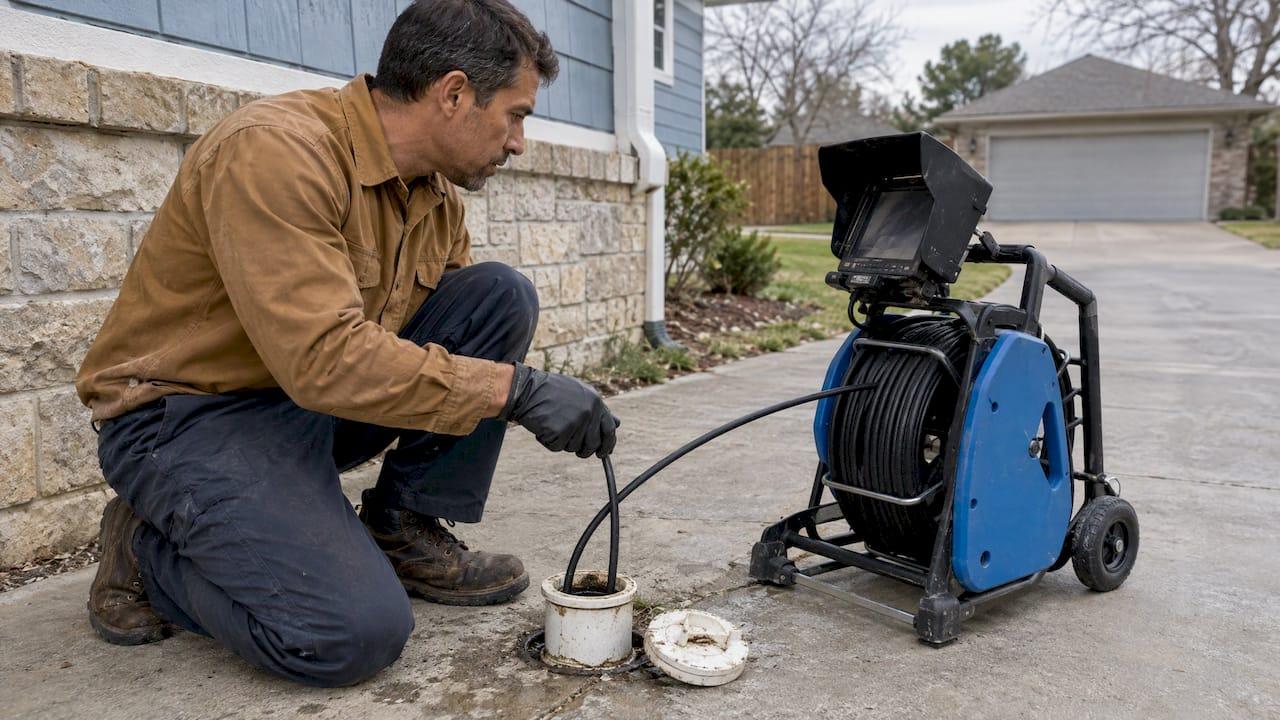
- The camera enters through a cleanout (a capped pipe access point) or a pulled toilet, and the plumber watches the live feed and records it.
- It finds roots, cracks, breaks, sags (called bellies), offsets, blockages and heavy buildup before they become a backup.
- Typical national pricing is roughly $100 to $500 for a basic scope. Access problems, long lines, locating and recording push it higher.
- Get the video and a written report. That record is your baseline for future inspections and the basis for any repair decision.
Table of Contents
- What a sewer camera inspection is
- How a sewer camera inspection works
- What the camera can find
- Who should get a sewer scope
- What a sewer camera inspection costs
- What a good report includes
- What happens after the scope
- Book a sewer camera inspection in Rogers, AR
- FAQ
- Sources
What a sewer camera inspection is
Your sewer line is the underground pipe that runs from the house, usually near the foundation, out to the municipal main, an HOA tap or a septic tank. You cannot see it, and most problems start out of sight. A cracked clay joint or a few roots look like nothing until the day the toilets stop draining.
The professional standard describes it plainly. InterNACHI's Sewer Scope Inspection Standards of Practice define a sewer scope as a video inspection of the lateral sewer line, from the house to the tap or septic tank, done to find and report visible defects and typically identify the pipe material.
One home inspector quoted by Realtor.com calls it a colonoscopy for your pipes. The comparison fits. A camera goes in, someone who knows what healthy looks like watches the screen, and you get an answer before there is an emergency.
People use several names for the same service: sewer camera inspection, sewer scope, sewer line video inspection, drain camera inspection. If a plumber says any of them, they mean this.
How a sewer camera inspection works
The process is short, usually under an hour on an accessible line. Here is what happens.
- Access. The plumber finds a way into the line. The best case is an exterior cleanout. Without one, the plumber may have to pull a toilet, which Realtor.com lists as the other common entry point.
- Camera pushed downstream. A flexible cable with a camera and light on the end is fed into the pipe. The plumber watches a monitor showing the view and the distance traveled.
- Identifying the line. According to the American Society of Home Inspectors, the plumber knows the camera has reached the city main when the pipe diameter grows from about 4 inches to 6 inches, the material changes or flowing water appears. The camera is then reviewed on the way back.
- Locating problems. A locator, a receiver that tracks the camera's signal from above ground, tells the plumber where a defect sits and how deep it is. Tools of this kind, such as underground water pipe locators, are what let a crew mark a trouble spot on your lawn instead of digging a trench to find it.
- Recording and report. The footage is saved so it can be reviewed later and the findings are written up.
The ASHI article notes that a typical camera reel is about 130 feet, which covers most residential runs. Very long lines may need extra planning.
What the camera can find
The inspection standards give a concrete list. InterNACHI requires inspectors to report conditions such as:
- visible cracks
- tree or plant root intrusion
- offsets (joints out of line) of more than ¼ inch
- more than 1 inch of standing water
- blockages or restrictions
- crushed, broken, separated or collapsed pipe
- excessive rust, scale or grease
- deteriorated concrete, egg-shaped (deformed) pipe, and delamination
In plain terms, these are the usual causes of slow drains, gurgling, repeated clogs and sewage backing into the house. The ASHI article also names bellies, which are low spots where water and waste collect. It says bellies raise the risk of blockage, freezing and eventual bowing or breaking of the pipe. It also points to accumulated debris, including flushable wipes, and root intrusion as common findings.
Roots deserve their own mention in Northwest Arkansas, where mature trees often stand between a house and the street. If the camera shows roots, our guide to tree roots in a sewer line explains the signs, fixes and costs.
Who should get a sewer scope
Homebuyers
A sewer line replacement is one of the largest repairs a house can need. Our breakdown of sewer line replacement costs puts a 50-foot replacement at $6,000 to $16,300. Realtor.com advises buyers to have a plumber complete the scope before closing and to choose one who specializes in drain work. It adds that most home inspectors do not include the scope, though some offer it as an option.
The scope matters most on older houses, houses with large trees between them and the street, and houses with clay or Orangeburg pipe, a tar-paper-like material used in older construction. Those are the lines where expensive surprises tend to turn up.
Homeowners with symptoms
Slow drains in more than one fixture, gurgling toilets, sewage smells in the yard, and backups after heavy use all point at the main line. The camera shows whether the cause is a clog, roots or a damaged pipe, so you pay for the right fix the first time.
Property managers and businesses
For a building with many fixtures, a recorded inspection gives you a documented condition of the line. It also helps you plan maintenance and budget for repairs instead of reacting to a backup in a tenant's unit.
Renovators
Before a bathroom or kitchen remodel adds fixtures and load, you want to know the line downstream can carry it. A scope settles that before walls are open.
What a sewer camera inspection costs
Prices vary by region, access and line length. Here is the published range, with the figures dated.
| Source and year | Basic scope | Notes |
|---|---|---|
| Realtor.com, 2025 | $100 to $250 | Range attributed to the International Association of Certified Home Inspectors |
| Powerwill, 2026 | $125 to $500 | National averages around $280 to $285 |
The same 2026 guide reports that a broader range of $270 to $1,730 appears in some consumer pricing guides. It also lists these price drivers:
- Pipe length. Lines under 50 feet often run $175 to $250. Runs of 50 to 100 feet run $250 to $400. Longer or more complex lines can reach $400 to $800.
- Access. No cleanout, or a toilet that has to be pulled, can raise the price to $175 to $750.
- Add-ons. Recording and reports add $50 to $150. Locating adds $40 to $100. Emergency service adds $100 to $300.
- Region. Labor rates move the price. The guide's city examples range from about $315 in Orlando to $1,600 in Los Angeles.
These are published ranges for their year, not a quote. Your own price depends on your line and your access point. For a Rogers, AR property, contact us for a plumbing video camera inspection quote.
If you are comparing quotes, compare what each includes: entry method, recording, locating and a written report. A low price for a scope with no video leaves you with nothing to show a seller, a lender or the plumber who does the repair.

What a good report includes
The camera is only half the value. The other half is what you walk away with. InterNACHI's standards call for a written report that identifies the portions of the line inspected and any areas not inspected, with reasons. A complete report answers these questions:
- Where did the camera enter, and was the cleanout accessible?
- How far did it travel, and did it reach the city tap, HOA tap or septic connection?
- Was the line blocked anywhere?
- Was the pipe material identified?
- Where is each defect, at what footage, and how serious is it?
- What is the next step?
These points follow a report-reading guide that cites the InterNACHI standards. It also makes a point worth keeping: a vague note such as "line may need replacement" is not enough to approve major work. You want a defect, a location and a severity.
The video matters too. The ASHI article says a recording becomes a baseline for future inspections, so you can see how the pipe changes over time. It is also useful information when it goes to the plumber who recommends corrective action. A clean line today can be rechecked after a few years, especially under mature trees.
What happens after the scope
The results usually fall into one of three groups.
The line is clear. You keep the video as a baseline. Many owners rescope every few years if the property has older pipe or large trees nearby.
The line is dirty or partly blocked. Grease, scale, debris and roots can often be cleared without digging. We use hydro jetting, which cleans the pipe with high-pressure water. Our hydro jetting cost guide covers what affects the price, and our hydro jetting service page explains the service.

The pipe is damaged. Cracks, offsets, breaks and bellies need repair. Depending on the pipe and the damage, that can mean trenchless repair, which fixes the line with minimal digging, or a traditional dig and replace. Our guides to how trenchless sewer repair works and trenchless repair costs show how to budget for each path.
Homes on septic instead of city sewer need a different inspection. See our septic inspection cost guide for that case.
Our view: scope with the people who can fix it
We do camera inspections every day as part of our plumbing work in Rogers, and we think the best scope is one where the plumber watching the screen is licensed, can explain what is on it in plain terms, and can handle the repair if one is needed.
That matters because a scope is only useful if it leads somewhere. A video of roots tells you nothing until someone tells you whether to jet the line, line it or replace a section. When inspection, drain cleaning, hydro jetting and trenchless repair come from one company, the findings go straight into a plan, and you get one point of contact instead of handing a video from one business to the next.
Our approach is built on transparent pricing, licensed technicians and rapid response. If you are buying, remodeling or watching a drain get slower, scope the line first. It is the cheapest way to know what you actually own.
Jonathan
Book a sewer camera inspection in Rogers, AR
JoCo Plumbing serves homeowners, businesses, property managers, buyers and renovators in Rogers and the surrounding area. Our plumbing video camera inspection lets us see inside your sewer or water line, and the same crew handles drain cleaning, hydro jetting, trenchless repair and traditional line repair when the footage calls for it.

If you have a backup right now, our emergency plumbing team responds quickly. For an inspection before a purchase or a remodel, request one through our water and sewer line repairs page.
FAQ
What is a sewer scope?
It is a video inspection of the line that runs from your house to the city main, HOA tap or septic tank. A plumber pushes a camera through the pipe and records what it sees. The goal is to report defects such as cracks, roots, breaks and blockages and to identify the pipe material.
How long does a sewer camera inspection take?
On a line with an accessible cleanout, most inspections are done in well under an hour. Time grows if the plumber has to pull a toilet, clear a blockage first or follow a long run. Your plumber can give you an estimate once they know your access point.
Does a regular home inspection include the sewer line?
Usually not. Realtor.com notes that most home inspectors do not include it, though it may be offered as an add-on. Buyers should arrange it separately with a plumber, ideally before closing.
How much does a sewer camera inspection cost?
Published national ranges for a basic residential scope run from about $100 to $500, with 2026 averages near $280 to $285. Long lines, no cleanout, locating, recording and emergency service raise the price. Request a quote for your property for an exact figure.
Should I get the video or just the report?
Get both. The written report gives the findings and the video lets you or a repair plumber see each defect at its footage mark. It also becomes a baseline you can compare with later inspections.
Sources
- InterNACHI's Sewer Scope Inspection Standards of Practice
- What Is a Sewer Scope Inspection? (Realtor.com)
- What Lies Beneath: Sewer Line Inspections (American Society of Home Inspectors)
- How Much Does a Sewer Camera Inspection Really Cost in 2026
- How to Read a Sewer Camera Inspection Report
- How to Use a Sewer Inspection Camera, Step by Step