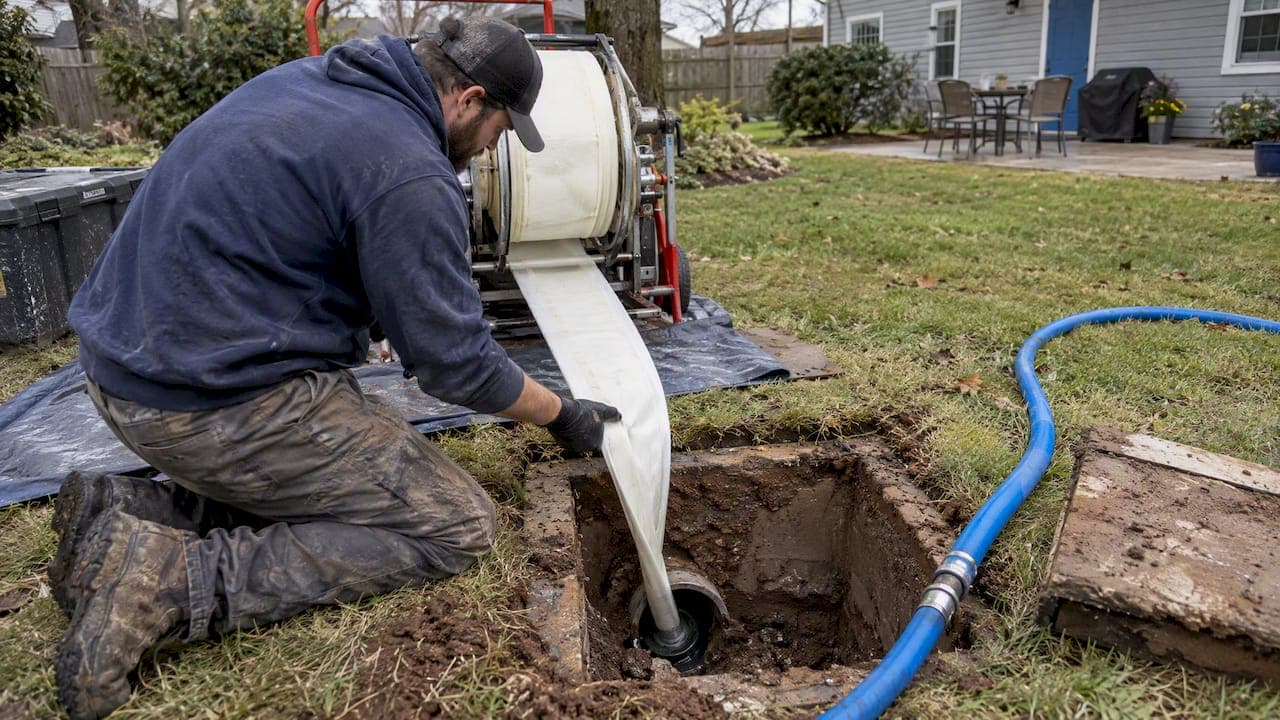
Trenchless sewer repair fixes or replaces a buried sewer line without digging a trench along its whole length. A plumber works through one or two small access points and uses the old pipe as a guide for a new liner or a new pipe. Your yard, driveway and landscaping stay mostly intact. It does not work on every line, and a camera inspection decides whether it works on yours.
This guide covers the main methods, what the job looks like, the real pros and cons, what it costs, and when open excavation is still the right call.
TL;DR
- Trenchless repair lines or replaces a sewer pipe through small access points instead of a full-length trench.
- The main methods are cured-in-place pipe lining, pipe bursting, sliplining and modified cross-section lining.
- It usually means less digging, less restoration and a shorter job. It can reduce pipe diameter, and a collapsed or misaligned line may still need excavation.
- A video camera inspection comes first. It shows the pipe's material, condition and defects, and that decides the method.
- Cost depends on length, depth, method and location. Get a written scope before you approve work.
Table of Contents
- What trenchless sewer repair is
- The main trenchless methods
- What the job looks like
- Pros and cons compared with digging
- When trenchless is not the right call
- What trenchless sewer repair costs
- Our perspective
- Trenchless repair in Rogers, AR
- Who is responsible for the sewer line
- Questions to ask before you hire
- FAQ
- Sources
What trenchless sewer repair is
The U.S. Environmental Protection Agency describes trenchless rehabilitation as using the existing sewer pipe as a host for a new pipe or liner, instead of excavating the entire line. The EPA says this generally means less restoration, less disturbance and less environmental damage than dig-and-replace.
You will also see it called no-dig sewer repair. The name is slightly generous. Access pits or maintenance holes may still be needed at the ends of the run or at a connection point. What disappears is the long open trench through your lawn, patio, driveway or landscaping.
The industry group NASSCO notes that no-dig technology can inspect, maintain and replace underground pipes while limiting disruption to sidewalks, parking lots, yards and streets. It can also avoid hauling the old pipe to a landfill.
For a homeowner, the practical point is simple. The pipe stays in the same corridor. You do not pay to remove and replace everything above it.

The main trenchless methods
The EPA fact sheet lists four main approaches: pipe bursting, sliplining, cured-in-place pipe and modified cross-section lining. Each fits different conditions. NASSCO's 2025 technology matrix stresses that suitability depends on pipe material, size, shape, condition and the capacity the line needs. No single method fits every job.
Cured-in-place pipe lining (CIPP)
CIPP is the method most homeowners meet first. A flexible liner soaked in resin is pulled or inverted into the old pipe. It is then cured with heat or ultraviolet light until it hardens into a new pipe inside the old one. NASSCO reports that CIPP creates a seamless structural pipe inside the deteriorated host pipe. It also says the method has been used for more than 50 years in pipelines from 2 to 120 inches in diameter.
Portland's environmental services bureau says CIPP requires little or no digging and suits short or long runs that do not need to be made larger. It is a good fit for cracks, leaking joints and roots working into a pipe that is still in line.
Pipe bursting
Pipe bursting replaces the pipe rather than lining it. The EPA describes pulling a bursting head through the old pipe so that it fractures or splits and is pushed outward while a new pipe is pulled in behind it. NASSCO identifies bursting as the trenchless replacement method that can upsize a pipeline.
Bursting suits a line that is too far gone to line, or one that needs a larger diameter. It needs an entry pit and an exit pit. It also moves soil. The EPA warns that dynamic bursting heads can cause settlement in surrounding ground, so it prefers static heads where conditions allow.
Sliplining and modified cross-section lining
Sliplining places a smaller-diameter pipe inside the existing one. The EPA notes that the gap between the two is typically grouted to prevent leaks and add structural integrity. Because the new pipe sits inside the old one, the inside diameter shrinks. Modified cross-section lining uses a liner that is temporarily reduced in size for insertion and then expanded to fit the host pipe.
On typical residential lines, most of the work you will be quoted involves CIPP or pipe bursting. Which one your plumber proposes should follow from the camera footage, not from habit.
What the job looks like
Every trenchless job follows the same broad sequence. Portland's CIPP guide lays out the steps, and the EPA fact sheet confirms that cleaning and inspection are typically required whichever method is used.
- Camera inspection. A camera runs through the line to find the break, the roots, the sag or the corrosion. This sets the method and the scope.
- Cleaning. Roots and debris are removed. Hydro jetting is a common way to clear the line before lining or bursting.
- Access. The crew digs one or two small pits, or uses an existing cleanout or maintenance hole.
- Bypass if needed. Flow is rerouted or paused so the line is dry enough to work on. Portland describes possible bypass and vacuum removal of water and debris as part of CIPP work. For bursting, the EPA says the segment must be taken out of service.
- Liner or new pipe goes in. The liner is inserted and cured, or the bursting head pulls the new pipe through.
- Reconnect and reopen. Service connections are reopened or reconnected.
- Final inspection. A second camera run confirms the new pipe is continuous, clear and properly connected.
You should expect to be without water drainage for part of a day while this happens. Ask your contractor for the expected window before work starts, and plan for showers, laundry and dishwasher use around it.
Pros and cons compared with digging
The Forbes Home guide to trenchless repair lists minimal property damage, lower labor and repair costs, faster completion and long-lasting results among the advantages. It also warns that the method may not work on severely damaged pipes. Here is how that plays out in practice.
| Factor | Trenchless | Traditional excavation |
|---|---|---|
| Digging | Small access pits only | Open trench along the full line |
| Yard, driveway, landscaping | Mostly left alone | Torn up and restored afterward |
| Time on site | Often shorter | Often longer, with restoration on top |
| Pipe diameter | Can shrink with some liners; bursting can upsize | New pipe at the size you choose |
| Badly collapsed or shifted pipe | May not be possible | Works on nearly any condition |
| Soil movement | Possible during bursting | Soil is removed and replaced |
| Disposal | Little old pipe hauled away | Old pipe and spoil to haul |
The advantages
- Less damage to what you own. Mature trees, a concrete patio or a finished driveway can stay in place.
- Less restoration. Fewer square feet of lawn, paving or flooring to rebuild.
- Faster in many cases. Less excavation and backfill usually shortens the schedule.
- A continuous pipe. A cured liner leaves a seamless interior, which helps keep roots out of old joints.
The drawbacks
- Smaller bore. Some liners reduce the internal diameter slightly. Whether that matters depends on the line size and the load on it.
- Not for every failure. Severe collapse or misalignment can mean a section must be dug up.
- Prep matters. The pipe has to be cleaned and inspected first. A poorly prepped line leads to a poor result.
- Still some digging. You will see small pits, even if you do not see a trench.
- Soil effects with bursting. Ground movement is a real project risk with dynamic bursting equipment, according to the EPA.
When trenchless is not the right call
NASSCO notes that age, infiltration, corrosion and root intrusion can all degrade a gravity sewer, compromising its structural integrity and causing backups and overflows. How far that damage has gone decides your options.
Lining and bursting are a fit when:
- The pipe has cracks, leaking joints or root intrusion.
- The line still runs in a reasonably straight path.
- Access at both ends is workable.
- You want to avoid cutting through a finished surface.
Open excavation is the safer path when:
- A section has collapsed or separated.
- The pipe has sagged or shifted so that water pools (a belly in the line).
- A connection or fitting needs to be rebuilt or relocated.
- The camera shows damage that a liner cannot span or seal.
The EPA says trenchless alternatives must be fully understood before application. For you, that means the camera footage comes first. Ask to see it. A plumber who proposes trenchless work without inspecting the line is guessing. So is one who rules it out the same way.
Roots are one of the most common reasons homeowners end up here. Our guide to tree roots in a sewer line covers the signs, the fixes and how to tell whether you have a root problem or a broken pipe.
What trenchless sewer repair costs
Price depends on pipe length and depth, the method, the pipe's condition, how hard the site is to reach, and where the break sits. A line that crosses a public right-of-way costs more to work on.
For a published reference point, Seattle Public Utilities reports that a no-dig sewer repair may cost $60 to $200 per foot, and that work in the right-of-way can cost more. That is one city's guidance, not a quote for Northwest Arkansas. Labor and site conditions differ by market, so use it as a range for planning and nothing more.
For a wider view of what replacement runs, see our breakdown of sewer line replacement cost. Trenchless and traditional methods both appear there.
To compare quotes fairly, make sure each one states:
- The method (lining, bursting or open dig).
- The length of pipe covered.
- Whether cleaning and the camera inspection are included.
- Who restores any surface that gets opened.
- What happens if the camera shows a section that cannot be lined.
Our perspective
Most sewer calls we hear about start the same way: a slow drain, a backup, a smell or a wet patch in the yard. By then the homeowner wants the problem gone and wants the yard left alone. Those goals can pull against each other, so we start with the line, not the method.
We put a camera in first. The footage tells us what is wrong, where it is and how bad it is. If the pipe is cracked, leaking at joints or full of roots, trenchless repair is often a clean answer. If the camera shows a collapsed or shifted section, we say so and explain why a dig is the better repair. We would rather tell you that up front than start a lining job that cannot hold.

Cleaning matters as much as the liner. We use hydro jetting to clear roots and buildup so the line is ready before any repair. Trenchless techniques are part of how we work, and we use them to cut disruption and get you back to normal faster. We also keep pricing clear. You should know what the work covers before you approve it.
One piece of advice we repeat: do not wait on a sewer problem. Small defects get bigger. A line that could have been lined can turn into one that needs digging.
— Jonathan
Trenchless repair in Rogers, AR
If you are dealing with a sewer line problem in Rogers or nearby, we start with a plumbing video camera inspection so the repair plan rests on what is in the pipe. From there we can tell you whether trenchless plumbing repair fits, or whether part of the line needs excavation.

We handle sewer and water line repairs, hydro jetting and emergency calls. If you have a backup right now, call us. If you want a second look at a quote you have already received, we can inspect the line and walk you through the footage. See our water and sewer line repair page to book.
Who is responsible for the sewer line
Responsibility varies by city and utility, and it affects who pays and who can work on which part of the line. Seattle Public Utilities, for example, explains that the private side sewer and the public right-of-way can involve different owners and different access rules, and it advises homeowners to use a side-sewer contractor for breaks or holes.
The general lesson applies anywhere. Before work starts, find out where your private line ends and where the public main begins. Check with your city or sewer utility about permit and inspection requirements for the repair. Do this before you sign, not after.
A backup can also come from somewhere other than the main line. If a floor drain is the only fixture backing up, read what to do when a floor drain backs up first. If you are on a septic system, the signs are different, and our guide to septic backup signs covers them.
Questions to ask before you hire
- Will you run a camera before quoting, and can I see the footage?
- Which trenchless method do you recommend, and why that one?
- Will the new pipe be smaller inside than the old one?
- Where will you dig access pits, and who restores the surface?
- Is cleaning included, and is there a final camera inspection?
- What happens if you find a section that cannot be lined?
- Are the permits and inspections covered in your quote?
A clear contractor answers these without hesitation. If the answers are vague, get another opinion.
FAQ
Is trenchless sewer repair worth it?
Often, yes, when the pipe is still in line and the damage is cracks, leaking joints or roots. It saves your yard, driveway and landscaping and usually shortens the job. It is not worth forcing onto a collapsed or shifted line, where digging is the sounder repair.
How long does a trenchless sewer repair take?
It depends on the length of the line, the method and how much cleaning the pipe needs. Many jobs are faster than a full excavation because there is less digging and restoration. Your plumber should give you a time window after the camera inspection.
Can every sewer line be repaired without digging?
No. Trenchless methods suit specific pipe conditions, and severe collapse or misalignment can require open excavation. A camera inspection shows which side of that line your pipe falls on.
Does trenchless repair mean there is no digging at all?
Not quite. Access pits or maintenance holes may still be needed to insert a liner or pull a new pipe. The difference is that these are small openings, not a trench along the whole line.
What is the difference between lining and pipe bursting?
Lining builds a new pipe inside the old one, so the old pipe stays in place. Pipe bursting breaks the old pipe apart and pulls a new one into its path, which also allows upsizing. The right choice depends on the condition of the pipe and the capacity you need.
Sources
- EPA Collection Systems O&M Fact Sheet: Trenchless Sewer Rehabilitation
- EPA Collection Systems fact sheet, pipe bursting (PDF)
- NASSCO: Trenchless Technology
- NASSCO: Technologies and Methods for Rehabilitation of Gravity Pipelines, 2025
- Portland.gov: Cured-in-Place-Pipe Lining
- Forbes Home: Trenchless Sewer Repair Guide
- Seattle Public Utilities: Troubleshooting Your Sewer Problem