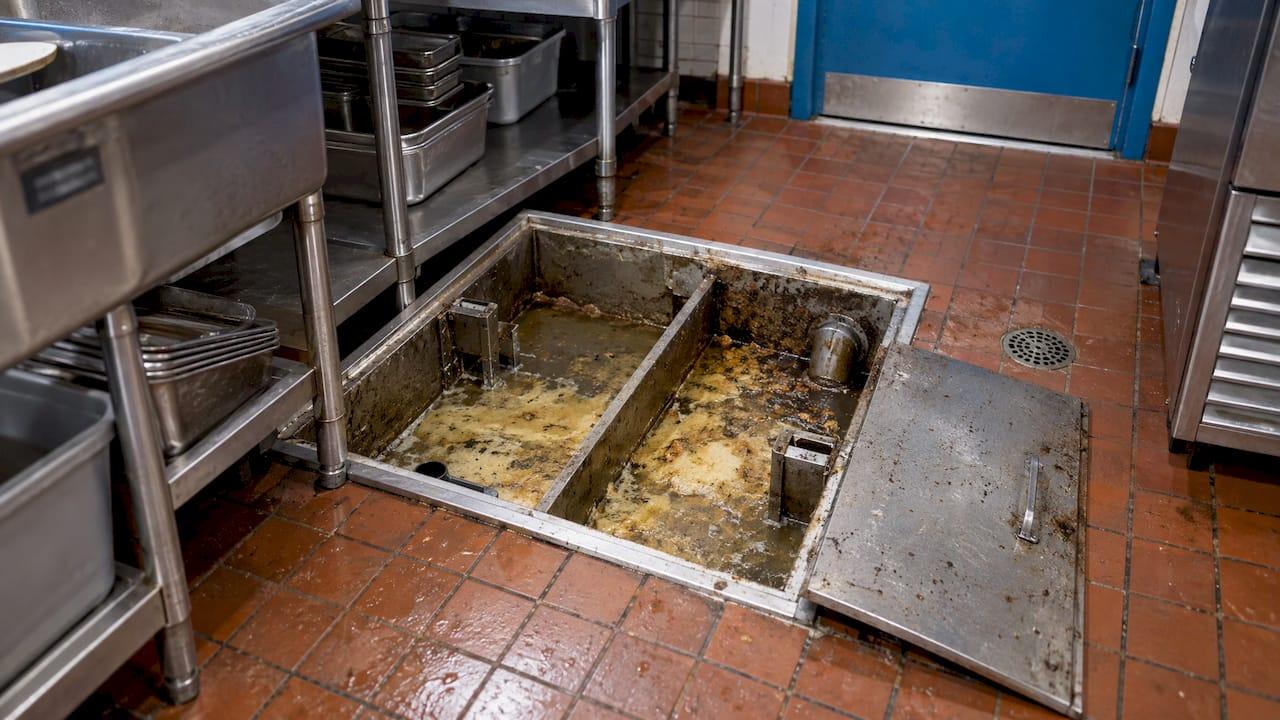
A grease trap needs a full cleaning at least every 30 days. A larger in-ground grease interceptor needs a full pump-out at least every 90 days. Either one needs service sooner when grease and settled solids fill 25% of its liquid depth. Keep a written log of every cleaning. Small under-sink units can be cleaned in-house, but larger units, and the drain lines that carry grease to them, belong with a licensed commercial plumber. In Rogers, AR, that is what we do at JoCo Plumbing through our commercial plumbing work.
This guide is for restaurant and food-service owners, property managers and landlords with a kitchen tenant, and buyers inspecting a property that has a grease device. It covers what to clean, how often, how to do it safely, what to record and what happens when maintenance slips.
TL;DR
- Traps: clean completely every 30 days or sooner. Interceptors: pump completely every 90 days or sooner.
- The 25% rule: when floating grease plus settled solids reach 25% of the liquid depth, the device is due now, whatever the calendar says.
- Cleaning means full removal: grease, water and sludge all come out, the walls and baffles are scraped, and no hot water, degreasers or soap go in.
- Records matter: log the date, who did the work and how many gallons came out. Keep the log on site.
- Grease lines downstream need attention too: a camera inspection and hydro jetting keep the pipe between kitchen and device clear.
Table of Contents
- Grease trap vs. grease interceptor: what you are maintaining
- How often to clean a grease trap or interceptor
- Signs your trap or interceptor needs service now
- How to clean a small grease trap, step by step
- Maintaining a large grease interceptor
- Keep the pipes in order too
- Records: what to keep and for how long
- What neglect costs
- Who handles what
- Our approach to grease systems
- Get your commercial drain lines checked
- FAQ
- Sources
Grease trap vs. grease interceptor: what you are maintaining
Both devices do the same job. They slow kitchen wastewater down so fats, oils and grease (FOG) float to the top and food solids sink, and only the clearer water in the middle moves on to the sewer. What differs is size and location.
- Grease trap (also called a hydromechanical interceptor): a small unit, usually under a sink or in the kitchen. Many have removable baffles and a lid with a gasket.
- Grease interceptor (also called a gravity interceptor): a large tank, usually buried outside, holding hundreds or thousands of gallons.
The maintenance principle is the same for both: remove everything that has collected, check the parts, put it back together, write it down. The tools and the schedule are different.
In Rogers, the city's water utility has its own FOG management policy. It requires new interceptors to be no smaller than 100 GPM (gallons per minute of flow) and sized for each food service space or future tenant. It also defines the 25% rule used throughout this article. If you operate in or near Rogers, read that policy first, because local rules set your actual interval and paperwork.
How often to clean a grease trap or interceptor
There is no single national number. Cities and counties set their own, but the published rules cluster tightly:
| Device | Typical minimum | Example source |
|---|---|---|
| Grease trap (hydromechanical) | Every 30 days | Charlotte County, FL, Metro Nashville |
| Grease interceptor (gravity) | Every 90 days | Charlotte County, FL, Metro Nashville |
| Hydromechanical unit under the James City/Hampton Roads policy | Before maximum capacity, and at least every three months | James City County, VA |
| Outdoor in-ground trap in Cheshire, CT | Quarterly, or earlier at 25% of depth | Town of Cheshire |
| Under-sink unit in Clemson, SC | Weekly | City of Clemson |
Treat these as examples of the range, not as your local rule. Your sewer utility's policy controls.
Why the calendar is only a minimum
A busy fry kitchen fills a trap far faster than a sandwich shop does. Sussex County, Delaware, says the right interval depends on how much FOG a facility produces and on its kitchen practices, so one fixed schedule does not suit every site. Sussex County's guidance ties cleaning frequency to both.

That is why the 25% rule exists. Metro Nashville's policy, effective October 1, 2024, requires a complete interceptor pump-out when floating FOG and settled solids together reach 25% of the liquid depth. For traps, content above 25% means cleaning every two weeks or as often as needed to stay under the line.
How to check the 25% line
- Open the lid and let any splashing settle.
- Measure the total liquid depth from the surface to the bottom.
- Measure the floating grease layer from the top, then the settled sludge from the bottom.
- Add the two. If the total is a quarter of the liquid depth or more, schedule service now.
For a buried interceptor, a measuring stick or sludge judge is the usual tool. If you cannot reach the bottom safely, or the tank is deep, have a plumber do the measurement. Never climb into an interceptor: the gases inside can be dangerous in a confined space.
Signs your trap or interceptor needs service now
Do not wait for the next scheduled date if you see any of these:
- Slow sink drains in the kitchen, especially at the pot sink, prep sink or dish machine.
- Foul odors from floor drains or near the device.
- Grease or sludge near the 25% line when you measure.
- Water backing up from a floor drain. Our guide on what to do when a floor drain backs up walks through the immediate steps.
- Repeated clogs in the same line even after clearing.
A backup in a working kitchen is an emergency: it can shut the line down mid-service. If that happens, our emergency plumbing repairs team handles urgent calls in Rogers and the surrounding area.
How to clean a small grease trap, step by step
These steps apply to small under-sink or countertop units. Follow the manufacturer's manual and your local utility's rules. They combine the common points from municipal guidance in Dothan, AL, Lake County, CA and James City County, VA.
- Prepare. Put on gloves. Have a sealable container, absorbent material and a scraper ready. Shut off flow to the unit.
- Open and remove the contents. Take off the lid, and remove baffles if the unit has removable ones. Take out all the grease, wastewater and settled solids. Partial skimming does not count.
- Scrape the surfaces. Scrape the walls and baffles clean.
- Skip the hot water, soap and degreasers. Dothan's instructions say to avoid hot water, degreasers and soaps. Sussex County also warns against hot water, acids, caustics, solvents and emulsifying agents. These can push grease through the unit and down the line.
- Inspect the parts. Check the inlet, outlet, baffles, flow restrictor and lid gasket. Replace anything missing, cracked or worn.
- Reassemble. Put the baffles back, seat the gasket properly and tighten the lid fasteners.
- Dispose of the waste correctly. Mix the grease and solids with absorbent in a sealed, non-glass container for trash disposal where your utility allows it. Never pour removed waste back into the trap, a private line or the sewer. James City County's policy prohibits that.
- Log it. Write down the date and the amount removed.
Where this goes wrong
The most common mistakes are skimming only the top layer, leaving sludge on the bottom, forgetting to restore the flow restrictor, and reusing a damaged gasket. Dothan's guidance stresses keeping the internal flow-control parts and gasket intact. Cleaning is not just removing visible grease.
Dothan also notes that units larger than 20 gpm or 40 pounds are usually serviced by a hauler or plumber. If your unit is that size, or you are unsure, our commercial plumbing team can look at it and the lines around it.
Maintaining a large grease interceptor
A buried gravity interceptor is not a do-it-yourself job. It needs a full pump-out, meaning the floating layer, the liquid and the sludge all come out. James City County's policy requires complete removal, and Sussex County advises that the facility witness the servicing, since the establishment stays responsible for the condition of its pretreatment device.
When the tank is empty, it is the moment to check:
- Inlet and outlet tees for damage or blockage.
- Baffles and walls for cracks or corrosion.
- Lids, risers and access covers for a proper seal.
- The sampling port, if the device has one.
Waste removed from the device must be disposed of under applicable regulations and must never be discharged into the sanitary sewer, according to Clemson's compliance program.
Keep the pipes in order too
The trap or interceptor is only one part of the system. Grease that gets past a full device, or that cools in the line before it arrives, builds up in the pipe. Two services help here:
- Plumbing video camera inspection. A camera on a flexible line shows what is inside the pipe: buildup, a sag, a cracked joint or roots. We offer plumbing video camera inspection in Rogers, AR. It is also useful for a buyer who wants to know the condition of a commercial property's drain lines before closing.
- Hydro jetting. High-pressure water scours grease off the pipe walls. Our hydro jetting service uses this method for drain cleaning.
If a drain keeps backing up even after the trap is clean, the cause is usually further along the line. Our post on drain backups and fixture clues shows how to narrow it down.
Records: what to keep and for how long
Inspectors ask for the log first. Metro Nashville's policy says to record the cleaning date, the person or company that did the work and the gallons of grease wastewater removed. Records must be on site, immediately available and kept for at least three years. Clemson says 12 months. Cheshire requires a written log and receipts. Taunton, Massachusetts, requires monthly inspection of external traps under its 2024 regulations, with logs submitted twice a year.
A practical log has these columns:
| Date | Device | Depth reading (% full) | Gallons removed | Done by | Notes (parts replaced) |
|---|
Keep receipts from any outside service with it. Metro Nashville also requires an annual inspection and certification of each trap or interceptor by a certified inspector, which shows how far some cities go. Ask your local utility whether it has a similar rule.
What neglect costs
Penalties vary by city, but Cheshire's published schedule gives a sense of scale: $100 for missing cleaning or inspection records, $200 for failing to clean quarterly or at the 25% trigger, and $1,000 for a sewer blockage attributed to the facility. The town can also bill the actual cost of an overflow. Metro Nashville says noncompliance can lead to enforcement action, costs and potentially termination of water service.

The larger cost is usually the shutdown. A kitchen with a backed-up line cannot serve customers.
Who handles what
| Task | Owner or staff | Licensed plumber |
|---|---|---|
| Daily scraping of plates and keeping grease out of drains | Yes | |
| Measuring the 25% line on a small trap | Yes | Yes |
| Cleaning a small under-sink trap | Yes | Yes |
| Large or buried interceptor service | Yes | |
| Camera inspection of drain lines | Yes | |
| Hydro jetting of grease-clogged lines | Yes | |
| Repair of cracked or collapsed lines | Yes |
Our approach to grease systems
We think of grease control as a system, not a single box. The trap or interceptor catches most of the grease, but the lines before and after it decide whether the kitchen runs on a busy Friday night.
What we want owners and property managers to take from this guide: measure against the 25% line, not just the calendar, and keep the log current. When a line keeps slowing down after the device is clean, look in the pipe. That is where our video camera inspection and hydro jetting come in. We clear the line and show you what we found.
We are licensed, we price transparently, and we respond fast when a kitchen drain stops. A grease problem rarely waits for a convenient time.
Jonathan
Get your commercial drain lines checked
We provide commercial plumbing maintenance and repair, hydro jetting, drain cleaning and plumbing video camera inspection for businesses, property managers and buyers in Rogers, AR and the surrounding area. If a kitchen drain is slow, a floor drain smells or a line keeps backing up, contact JoCo Plumbing through our commercial plumbing page and we will help you find the cause.

For a drain that has already stopped, go to our drain cleaning and repair page.
FAQ
How often should a grease trap be cleaned?
At least every 30 days under many municipal policies, including Metro Nashville and Charlotte County, FL. Clean it sooner if grease and solids fill 25% of the liquid depth. Your local sewer utility sets the actual interval, so check its policy.
How often should a grease interceptor be pumped?
Generally at least every 90 days, or earlier when floating grease and settled solids reach 25% of the liquid depth. Some utilities allow a different interval only with written approval. Rogers Water Utilities publishes its own FOG policy for local operators.
Can I clean a grease trap with hot water or degreaser?
No. Municipal guidance from Dothan and Sussex County says to avoid hot water, degreasers, soaps, acids and solvents. They can carry grease through the device into the sewer line, where it hardens and causes blockages.
What should I record after each cleaning?
The date, who performed the service and the gallons removed. Metro Nashville requires the records to be on site and kept for at least three years. Other cities set shorter periods, so confirm your local rule.
My drains still back up after the trap was cleaned. What now?
The blockage is probably in the line. A camera inspection shows what is inside the pipe, and hydro jetting can clear grease buildup. Call us in Rogers, AR to have the line inspected.
Sources
- Maintenance Procedures, Lake County, CA
- Fats, Oils and Grease Program and Policy, James City County, VA
- Cleaning a Hydro-Mechanical Grease Interceptor, Dothan, AL
- Grease Trap and Interceptor Maintenance, Sussex County, DE
- Metro Water Services FOG Policy 2025, Nashville
- FOG BMP Guide, Charlotte County, FL
- FOG Program Policy, Town of Cheshire
- Oil Water Separation Compliance Program, City of Clemson
- Board of Health FOG Regulations 2024, City of Taunton
- FOG Management Policy, Rogers Water Utilities