A private lift station needs a written maintenance routine: a quick alarm and visual check every week, monthly motor readings, quarterly pump and float inspections, and a wet well cleaning at least twice a year. That is the pattern in EPA training material and in county guidance for private owners. Below is what each task involves, which signs mean trouble, what to do when the alarm sounds and where a licensed plumber fits in.
If you own a commercial building, an apartment complex, a subdivision or a home that sits below the sewer main, this lift station is yours to maintain. Failure means sewage backing up into buildings or overflowing onto the ground.
TL;DR
- Private lift stations are the property owner's responsibility. Skipping maintenance leads to equipment failure and can cause a sanitary sewer overflow.
- Common schedule: alarms weekly, motor amps monthly, pumps and floats quarterly, wet well cleaning and check valves twice a year, electrical controls semi-annually.
- Rising run times, odors, unusual noise or an alarm that keeps cycling are signs to call a plumber now.
- Never open or enter the wet well. It is a confined space with serious air and entrapment hazards.
- Keep a logbook. Follow the manufacturer's instructions and your local sewer rules first.
Table of Contents
- What a lift station does and why it needs upkeep
- Lift station maintenance schedule at a glance
- Weekly and monthly checks
- Quarterly and twice-yearly tasks
- The annual inspection
- Keep a maintenance log
- Warning signs that call for service
- What to do when the alarm sounds
- Safety: do not enter the wet well
- Check your local rules and the manufacturer's manual
- Perspective: why we push for routine service
- Lift station service in Rogers, AR
- FAQ
- Sources
What a lift station does and why it needs upkeep
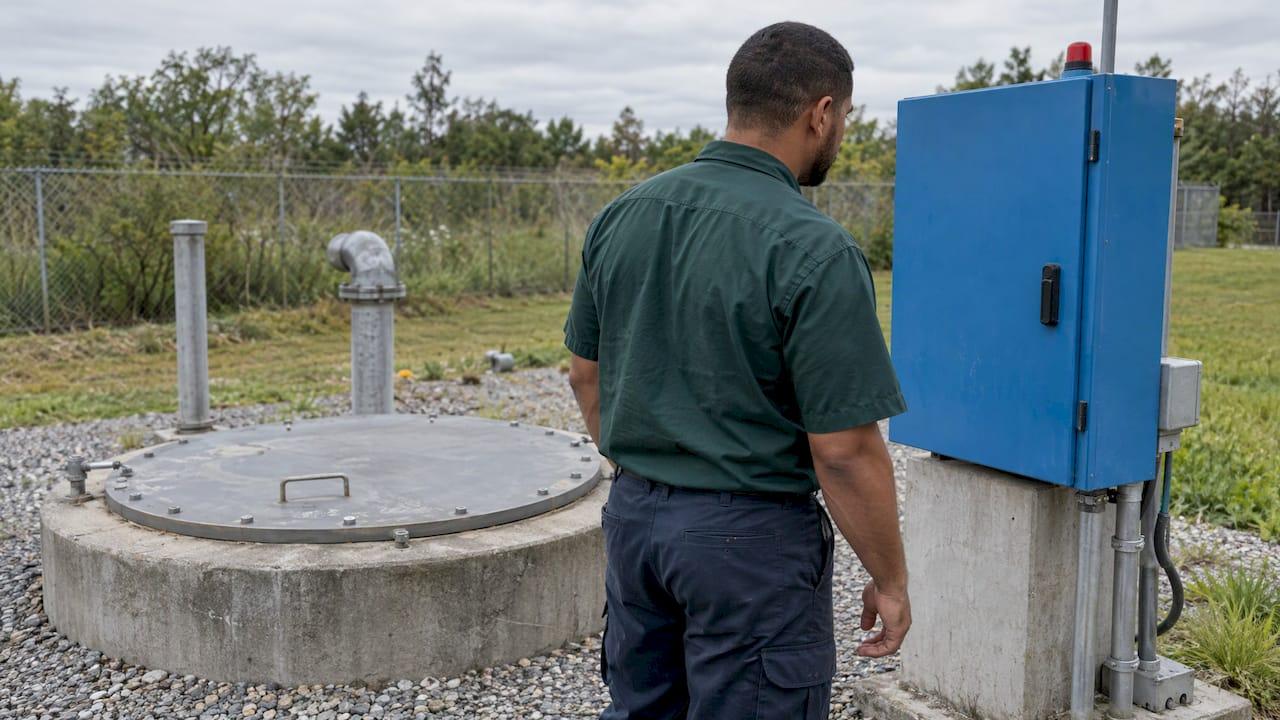
A lift station is an underground facility with submersible pumps. It moves wastewater from a lower elevation up to a sewer line at a higher one. Builders install them where the grade does not allow gravity flow.
The station has several parts that all have to work together:
- Wet well: the basin where wastewater collects.
- Pumps and impellers: move the wastewater out.
- Floats: tell the pumps when to start and stop.
- Check valves: stop flow from running back into the well.
- Alarm system: warns of high water.
- Control panel: runs it all.
The same county guidance lists pumps, floats, check valves, alarms and control panels as the components that fail without routine care.
The stakes are high. A 2022 Environmental Finance Center Network article notes that a high level of reliability is needed, because failures can send raw wastewater out of the system, creating compliance problems and threatening public health and the environment.
Preventive maintenance also pays off in cost. The EPA's CMOM guide says it reduces breakdowns and emergency repairs, keeps equipment in service longer and extends equipment life, which avoids premature replacement.
Lift station maintenance schedule at a glance
Use this table as a starting point. Frequencies come from the EPA webinar and the Clark County, NV owner flyer. Your manufacturer and local authority may ask for more.
| Task | Typical frequency |
|---|---|
| Check alarm and light systems | Weekly |
| Visual walk-around of the site | Weekly or more often |
| Amp readings on each pump motor | Monthly |
| Inspect pumps and impellers | Quarterly |
| Clean and inspect floats | Four times a year |
| Pump out and clean the wet well | At least twice a year |
| Inspect check valves | At least twice a year |
| Inspect electrical motor control equipment | Semi-annually |
| Drawdown test and pump pull inspection | Annually |
Sources: the EPA webinar slides, the Clark County flyer and a 2025 EFC Network presentation for the annual items.
Weekly and monthly checks
Alarm and light tests
The alarm is your early warning. It signals high water or a possible overflow, and it should be both audible and visual. When rising water lifts the float closest to the lid, the alarm turns on, according to Hillsborough County, FL.
Test the alarm and light every week. An alarm that has never been tested is a guess.
Site walk-around
Look at the cover, the panel, the valve box and the area around the station. Check for standing water, odors, damaged covers, a missing emergency contact sign or anything blocking access. County guidance for private owners recommends posting an emergency contact sign where the public can see it. The Hillsborough County page lists locked panels and wells as part of its requirements.
Monthly amp readings
Motor amperage tells you how hard each pump is working. Take readings monthly and write them down. A pump that draws more or less current than it used to, or than its twin, is telling you something before it fails. Installing motor hour meters also lets you compare run time between pumps, a step the EPA webinar recommends.
Quarterly and twice-yearly tasks

Pumps and impellers
Inspect submersible pumps and impellers quarterly. Grease, wipes and debris wrap around impellers and cut flow. This work usually means pulling the pump, so it is a job for a trained technician with the right lifting gear.
Floats
Floats should be cleaned and inspected four times a year. Grease and debris can keep floats from signaling the pumps to turn on, as Hillsborough County points out. A coated, tangled or stuck float is a common reason for a flooded wet well.
Check valves
Inspect check valves at least twice a year. When grease and solids hold a check valve partly open, motor run time rises noticeably because the pump keeps moving the same wastewater again.
Wet well cleaning
Pump out and clean the wet well at least twice a year, more often if needed. Built-up solids and grease cause odors and can damage the pump, according to the EPA webinar. Stations that serve restaurants, food prep or laundry often need more frequent cleaning because they send more grease downstream. Hydro jetting is one way to clear the inlet piping that feeds the station.
Electrical controls
Have the motor control equipment inspected semi-annually. Panels, contactors, relays and wiring are checked by a licensed professional and not by guesswork.
The annual inspection
Once a year, step up the scope. According to the 2025 EFC Network presentation, annual work includes cleaning the wet well, running a drawdown test and pulling and inspecting the pumps.
A drawdown test checks each pump's flow rate. The operator runs one pump by hand to empty a known volume from the wet well and times it. The same presentation gives the volume formula: diameter squared times 0.785 times the drop in water height times 7.48 gallons per cubic foot. Compare results to last year's. A slower time means wear, clogging or a failing check valve.

Keep a maintenance log
Write everything down: dates, motor hours, amp readings, cleanings, parts replaced, alarm tests. The EPA's CMOM guide calls recordkeeping the basis of a good predictive maintenance program, since only accurate records establish baseline conditions and highlight problem areas.
A log also helps your plumber. Instead of guessing, the technician sees trends in amps and run time and can plan repairs before a failure.
Warning signs that call for service
Call a plumber if you notice any of these:
- Longer run times. Differences in run times between pumps can point to a partly blocked check valve, a clogged impeller or a motor problem.
- Pressure changes on the force main. Rising pressure over time can mean a clogged pipe or valve. Falling pressure can mean a break or leak.
- Slow drainage in the building. Fixtures that drain slowly or gurgle can mean the station is not keeping up.
- Odors. Sewage smell near the station or wet well.
- Unusual noise or vibration. Buzzing, grinding or pumps that hum without pumping.
- An alarm that comes back. Especially one that cycles on and off or stays on.
When a station fails because of a force main break, power outage or pump failure, wastewater collects in the wet well and can back up into buildings or overflow outdoors. Finding an underground leak on a force main often requires locating equipment such as a water pipe leak detector, plus a technician who knows how to read the results and make the repair.
What to do when the alarm sounds
A high-level alarm means wastewater in the wet well is rising past the normal pumping range. The pumps are not keeping up. Take these steps:
- Reduce water use right away. Stop laundry, dishwashers and long showers. Ask tenants or staff to do the same.
- Do not silence the alarm and carry on. Silencing it hides the problem.
- Call your service company or the 24-hour number on the station sign.
- Do not open or enter the wet well. See the safety section below.
- Note what you see. Is the alarm steady or cycling? Is the panel tripped? Any recent power outage? Tell the technician.
An alarm that sounds once during a heavy water surge and clears in minutes may just be the pumps catching up. An alarm that stays on or keeps cycling points to a pump, a float or the controls. Have it looked at.
The EPA's CMOM guide advises owners to have a plan for routine emergencies such as overflowing manholes, line breaks and power outages at pump stations. Write your plan down: who to call, who shuts off water use and where the panel is.
If sewage is already backing up inside, see our guide on what to do when a floor drain backs up.
Safety: do not enter the wet well
Lift stations are confined spaces. The CCPIA warns of unsafe air, engulfment and entrapment, and says specialized training and qualification are required to enter them.
For owners, the rule is plain:
- Never climb into or lean into the wet well.
- Do not open the cover without trained help and proper gas monitoring.
- Keep the cover and panel locked.
- Leave pump pulls, cleaning and electrical work to trained, licensed technicians.
Electrical work on the panel should stay with a licensed professional.
Check your local rules and the manufacturer's manual
The base of your schedule should be the equipment manufacturer's recommendations. The EPA's CMOM guide says to adjust that schedule with site-specific knowledge.
Local rules may add requirements. As one example, Hillsborough County, FL requires private lift stations to have two approved, operational pumps that alternate, working floats, audible and visual alarms, a locked wet well and panel and posted emergency contact information. Those are Florida county rules, not a national standard. In Arkansas, ask your city or sewer utility what it requires for private stations, and keep a copy of the manual and permits with your log.
Perspective: why we push for routine service
Most lift station calls we hear about start the same way. An alarm has been sounding for a while, or a pump has been running nonstop, and nobody has looked at the station since the last problem.
We think the cheapest lift station repair is the one you schedule. A planned wet well cleaning, a float check and a pump pull are short jobs. An overflow, a flooded building or a burned-out pump is not.
Our approach is simple. We inspect the pumps, floats, check valves and controls, tell you what we find in plain terms and give you clear pricing before work starts. If a pump needs repair or replacement, we handle it. If the inlet or outlet piping needs attention, we can use drain cleaning, hydro jetting and video camera inspection to see what is going on inside the line.
Keep your log, test your alarm and call early. We are here for the rest.
Jonathan
Lift station service in Rogers, AR
JoCo Plumbing handles pump installation and repair, including lift station, sewage ejector, grinder, sump, booster and well pumps, for homes, businesses and property managers in Rogers and surrounding areas. Our technicians are licensed, and we offer emergency repair when a station fails.
See our sewer lift station repair page, or call us for emergency service.

Other pump services that tie into the same system include sewage ejector pump repair and installation and grinder pump repair. If your building also uses a basement ejector pump, our guide to sewage ejector pump problems covers the signs. For an urgent problem, use our emergency plumbing repair service.
FAQ
How often should a lift station be serviced?
Inspect it weekly, take motor readings monthly, and check pumps and floats quarterly. Clean the wet well and check valves at least twice a year, per the EPA webinar. Follow the manufacturer's schedule where it asks for more.
Who is responsible for a private lift station?
The property owner is responsible for maintaining a private lift station, according to Clark County, NV guidance. Public stations are typically run by the city or sewer department. If you are unsure which one serves you, ask your utility.
What causes a lift station alarm to go off?
The alarm signals high water in the wet well. Causes include a failed pump, a stuck float, a clogged impeller or check valve, a power loss or a tripped control. If it stays on or keeps cycling, call a plumber.
Can I clean the wet well myself?
No. The wet well is a confined space with unsafe air and entrapment risks, and the CCPIA says trained and qualified people are required to enter it. Have a licensed plumber or pumping service handle it.
What should I keep out of the lift station?
Grease, wipes, rags and debris. Hillsborough County notes that grease and debris shorten pump life and can interrupt the floats that start the pumps. Post a notice for tenants and staff.
Sources
- Private Lift Stations best management practices flyer, Clark County, NV
- Collections and Lift Station Maintenance webinar slides, EPA
- Guide for Evaluating Capacity, Management, Operation, and Maintenance (CMOM), EPA
- Lift Station Operation and Maintenance, Environmental Finance Center Network
- Lift Station Operation and Maintenance presentation, Environmental Finance Center Network
- Lift Stations, Hillsborough County, FL
- Understanding lift stations, WSB
- Overhead Sewer Systems and Lift Stations, CCPIA