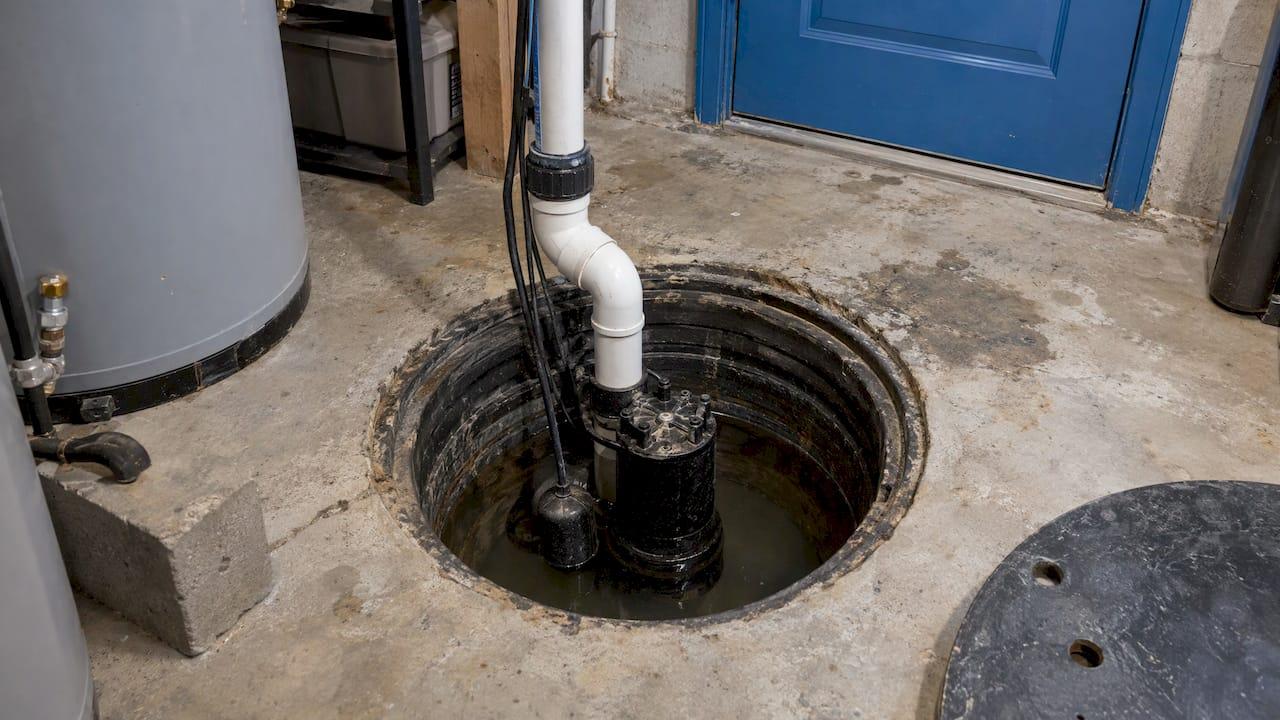
Sump pump maintenance comes down to four jobs: test the pump, clean the pit and pump, check the discharge line, and check the power and backup. Test every few months. Clean at least twice a year. Do a full check before storm season. Call a plumber when the pump will not start, runs constantly or makes new noises.
A sump pump sits unused for weeks, then has to work perfectly during the worst storm of the year. Ten minutes of checking at the right times is what makes that happen. This guide gives you the schedule, the steps, the safety rules and the warning signs.
TL;DR
- Test the pump by pouring water into the pit. Do it every few months and before heavy storms.
- Clean the pit and the pump inlet screen at least twice a year. Clean more often if the pump also handles washing machine water.
- Check the discharge line, the check valve, the outlet and the battery backup. These fail as often as the pump itself.
- Unplug the pump before you touch it. Never reach into the pit while the pump is powered.
- Constant running, no start, grinding, burning smells or leftover test water mean it is time to call a licensed plumber.
Table of Contents
- How often to service a sump pump
- Safety before you start
- How to test a sump pump
- How to clean a sump pump and pit
- The sump pump maintenance checklist
- Warning signs your pump needs service
- What a professional inspection covers
- Sump pump service in Rogers, AR
- Quick seasonal schedule
- FAQ
- Sources
How often to service a sump pump
There is no single number, because advice depends on how hard your pump works. Here is what the main guides recommend:
| Task | Frequency | Source |
|---|---|---|
| Water test | Every few months, and before big storms | Farmers Insurance |
| Clean basin and pump | Twice a year | Farmers Insurance |
| Check discharge line | Every 3 to 4 months and before winter | Farmers Insurance |
| Clean pump screen or inlet | Monthly if the pump handles washing machine water, otherwise every 3 to 4 months | Allstate |
| Remove pump and clean pump and pit | Annually | Allstate |
| Professional inspection | Once a year, and when the home is sold | Allstate, InterNACHI |
Some sources set the floor lower. Bob Vila says at least once a year, and quarterly if your area gets a lot of rain or snow. The City of Ann Arbor's maintenance checklist says at least twice a year, preferably before the spring snow melt.
A simple rule that covers all of these: test quarterly, clean twice a year, and have a plumber look at the whole system once a year. In northwest Arkansas, that means a full check before the spring storm season and another in the fall.
Safety before you start
A sump pump is an electrical appliance sitting in water. Treat it that way.
- Power the pump completely off before maintenance. AHS Home Team warns that working on an electrified pump can be dangerous and recommends safety equipment.
- Never reach into the pit during a test. InterNACHI says to use a non-conductive item, such as a golf club with a rubber handle, to move the float.
- Pentair gives the same advice for lifting a float switch to the on position: use a broom handle or a similar non-conducting object to avoid possible electric shock.
- Wear gloves when you handle debris from the pit.
If the pit is full of water and the pump is not running, stay out of the basement area near it and call a plumber.
How to test a sump pump
This is the most useful five minutes of the whole routine.
- Make sure the pump is plugged in and the outlet has power.
- Slowly pour a five-gallon bucket of water into the pit. Farmers Insurance and Family Handyman both describe this method.
- Watch the float rise. The pump should switch on and move the water out through the discharge pipe.
- Confirm it shuts off by itself once the water level drops.
- Go outside and check that the water is leaving at the discharge point.
If the water stays in the pit, Family Handyman says the cause is generally the pump, the check valve or the power supply. InterNACHI advises getting professional help if the pump does not activate.
Testing the float switch separately
If the pump does not start when the water rises, the float may be the problem. Pentair describes a piggyback plug test: unplug the float switch, plug the pump directly into the wall, and the pump should run right away. Do not leave it running that way for more than a few minutes, because it can overheat. If the pump runs on direct power but not through the float, the switch needs attention.

Testing the battery backup
Repeat the water test with the main power disconnected. Family Handyman describes this approach for battery backups. Plug the main pump back in afterward. Follow the manufacturer's instructions for testing, and replace batteries on the schedule it gives. Farmers Insurance notes this is often every few years. For more on backup systems, see our guide to battery backup sump pumps.
How to clean a sump pump and pit
Cleaning is the job most people skip, and silt and debris are a common cause of stuck floats and clogged impellers. The Ann Arbor checklist specifically tells you to inspect the pit for silt and debris that could block the float, clog the impeller or plug the discharge tube.
The steps below follow the process Farmers Insurance outlines for twice-a-year cleaning:
- Unplug the pump. Unplug the battery backup too, if you have one.
- Disconnect and remove the pump if you can reach it safely.
- Clear debris from the pit. AHS Home Team describes wearing gloves and lifting debris into a nearby bucket.
- Wipe down the outside of the pump.
- Clean the intake screen or inlet opening.
- Reinstall the pump so it sits upright and the float moves freely. InterNACHI says to make sure the float is not tangled or jammed.
- Restore power and run a water test.
Do not put the pump directly on gravel or dirt at the bottom of the pit. Debris gets drawn into the inlet that way.
The sump pump maintenance checklist
Use this list for your seasonal check. Print it and keep it near the pit.
Pump and pit
- Float moves freely and is not tangled or jammed against the wall of the pit.
- Pit is free of silt, stones and trash.
- Intake screen is clear.
- Pump sits upright.
- Pit has a cover. InterNACHI lists a cover, an alarm, a check valve and a backup power source among the items to verify. For most homes it also lists a pit at least 24 inches deep and 18 inches wide.
Discharge line and check valve
- Discharge pipe is not cracked, corroded, crushed or leaking. The Ann Arbor checklist says to check the line from the pump to the air gap for corrosion, holes, damage or leaks.
- The small weep hole in the discharge pipe just above the pump is clear. The same checklist puts it at 3/16 to 3/8 inch, and says to add one if missing, to prevent a possible airlock.
- Check valve is in place so water does not flow back into the pit.
- Water exits at least 20 feet from the home and away from neighboring properties, according to Allstate.
- Check the discharge line before winter, as Farmers Insurance recommends, so nothing blocks it in freezing weather.
Power and backup
- Pump is plugged directly into an outlet. Pentair says extension cords, or outlets shared with other devices, can cause low voltage. That makes the pump draw more amps and run hotter, which shortens motor life. Pentair recommends the pump be the only thing on its circuit.
- Outlet or GFCI works. Cords are not frayed.
- Alarm sounds when tested. InterNACHI says a water alarm is especially valuable where a home sits unoccupied for long periods.
- Battery backup passes a test and its batteries are within their service life.
Outside the house
Water that never reaches the pit is water the pump never has to move. Keep gutters and downspouts clear and pointed away from the foundation. Seal visible foundation cracks. Cover window wells: basement window covers are one way to keep rain and debris out of them. PlumbWize and others list the same habits as part of regular pump care.

Warning signs your pump needs service
Farmers Insurance lists the signs that point to a stuck float, a clogged intake, a blocked discharge line or general wear:
- The pump runs constantly or cycles often when conditions are dry.
- It does not turn on when the water rises.
- It makes grinding, rattling or humming noises.
- It vibrates a lot.
- You see rust, corrosion or debris buildup.
- You smell something musty or burnt, which can mean an electrical or mechanical problem.
One or two of these after a good cleaning is your cue to call. For a longer walk-through of each symptom, read our guide to sump pump failure signs.
Age matters too. Hanover Insurance is among the insurers that put average-use pump life at roughly 7 to 10 years, and shorter if the pump runs often. If yours is old and failing tests, check what replacement involves in our sump pump replacement cost breakdown.
What a professional inspection covers
Allstate says a yearly professional inspection can help confirm the pump works and prolong its life. A thorough visit covers:
- The pit, the pump and the float action
- The check valve
- The backup power source and alarm
- The cover
- Where the discharge ends up
Have it done before spring, and also when buying or selling a home.
Our view on sump pump care
We see the same pattern on service calls. The pump that fails during a storm is rarely a brand-new pump. It is a pump with a stuck float, a clogged inlet, a dead backup battery or a discharge line that was never checked.
That is why we treat maintenance as a system check, not a pump check. We look at the float, the pit, the check valve, the discharge and the power source together. Any one of them can let water into a basement.
Our approach is simple. Test it yourself every few months. Let a licensed technician inspect it once a year. If the pump is failing, we repair or replace it, and we tell you which makes sense before any work starts.
Sump pumps, sewage ejector pumps, grinder pumps and well pumps all run on the same basics: clean, powered, tested. We install and repair all of them in Rogers and the surrounding area.
Jonathan
Sump pump service in Rogers, AR
If your pump will not start, fails the water test or is due for an annual inspection, we can help. JoCo Plumbing handles sump pump installation and repair, including backup systems, with licensed technicians. See all of our pump services.

Water already coming in? Call us for emergency plumbing repairs. If the water is coming up through a floor drain instead of the pit, read what to do when a floor drain backs up. A sewage ejector pump that is failing is a different problem, covered in our guide to sewage ejector pump problems.
Quick seasonal schedule
- Late winter: full system check before spring storms. Test, clean, check the discharge line and battery.
- Early summer: water test and inlet screen check.
- Early fall: clean the pit, test the backup, clear gutters.
- Before the first freeze: check the discharge line so it drains and nothing blocks it.
- After any big storm: a quick test and a look at the pit.
FAQ
How often should I service my sump pump?
Test it every few months and before major storms. Clean the pit and pump at least twice a year, and have a professional inspect it once a year. If it handles washing machine water, clean the inlet screen monthly, per Allstate.
How do I clean a sump pump?
Unplug it, lift it out if you can do so safely, and clear the pit of debris while wearing gloves. Wipe the pump, clean the intake screen, set it back upright and restore power. Finish with a bucket test to confirm it runs and shuts off.
How do I test my sump pump?
Pour about five gallons of water slowly into the pit. The float should rise, the pump should start and push the water out, and then it should shut off by itself. If the water stays in the pit, InterNACHI advises getting professional help.
Do I need a battery backup?
A backup protects you when the power goes out, which often happens during the storms that fill the pit. Test it with the main power disconnected and replace batteries as the manufacturer recommends. We install and repair backup systems with sump pumps.
Sources
- Sump Pump Maintenance: A Homeowners Guide, Farmers Insurance
- Maintenance Checklist, City of Ann Arbor
- Sump Pump Operation and Inspection Guide, InterNACHI
- Sump Pump Maintenance: 6 Crucial Tips, Bob Vila
- Sump Pump Maintenance and Inspection Tips, Allstate
- Sump Pump Maintenance, Inspection, and Testing, AHS
- Sump Pump Troubleshooting FAQ, Pentair
- How to Test Sump Pumps Easily, Family Handyman
- Simple tips to maintain your sump pump, Hanover Insurance
- 8 Essential Sump Pump Maintenance Tips, PlumbWize