
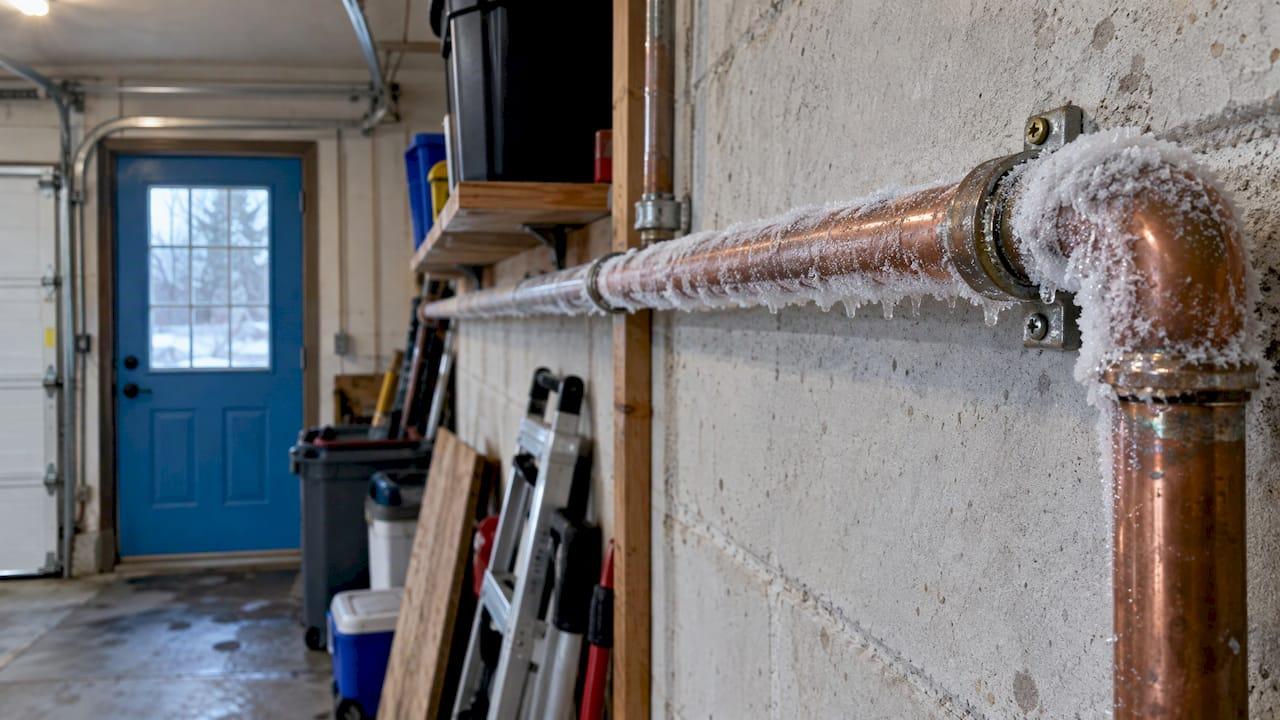
If you suspect a frozen pipe, open the affected faucet, find your main shut-off valve, and warm the pipe slowly with a hair dryer or heating pad. Never use an open flame. If you see water leaking, or you can't find or reach the frozen section, shut off the main valve and call a licensed plumber. Below are the signs, the thawing steps, what to do if a pipe bursts, and how to keep it from happening again.
TL;DR
- A faucet that gives only a trickle is the most common sign of a frozen pipe. Check exterior walls and the spot where the water line enters through the foundation.
- Know where your main shut-off valve is before you start. Close it right away if you see any leak or standing water.
- Thaw slowly with a hair dryer, an electric heating pad, or towels soaked in hot water. Never use a blowtorch or any open flame.
- Do not try to thaw a pipe that is leaking or sitting in water. Shut off the main valve and call a licensed plumber.
- To prevent a repeat: keep the heat on, open cabinet doors, and let a faucet drip on very cold nights.
Table of Contents
- How to tell a pipe is frozen
- What to do first
- How to thaw a frozen pipe safely
- When a frozen pipe leaks or bursts
- Who to call for frozen pipes
- How to prevent frozen pipes
- Our perspective
- Frozen pipes in Rogers, AR: when to call JoCo
- FAQ
- Sources
How to tell a pipe is frozen
The first sign is usually at the tap. You turn on a faucet and get a trickle or nothing at all. The American Red Cross lists a trickle as a likely sign of a frozen pipe. Seattle Public Utilities says the same.
What to check:
- One faucet or several? If only one fixture is affected, the freeze is probably in the line feeding it. If every tap is dry, the freeze may be closer to where the main line enters the house.
- Does a neighbor have water? If neighbors have water and you don't, a frozen pipe is more likely than a municipal outage. If they have none either, the problem may be a main break. Protect Your Pipes suggests this check first.
- Where are the cold spots? The Red Cross names pipes against exterior walls and places where water service enters the home through the foundation as likely spots for freezing. Look in crawl spaces, unheated basements, garages, and under sinks on outside walls.
- Any visible frost or bulging? Frost on an exposed pipe tells you where to start. A visible crack, bulge, or drip means you should skip thawing and go straight to the shut-off steps below.
A frozen pipe is not yet a burst pipe. It is still a warning. Ice blocks the flow, and a blockage can put stress on the pipe. Acting early gives you the best chance of avoiding water damage.
What to do first
Take these steps in order.
- Locate your main shut-off valve. It is usually where the water line enters the house, often in a basement, crawl space, or utility area. Protect Your Pipes advises turning off water at the main valve right away when you find a frozen pipe. Having it closed means that if the pipe cracks as it thaws, water won't pour out.
- Open the affected faucet. The same source says an open faucet lets water flow once the ice melts, and that flow helps melt more ice. Leave the tap open while you thaw.
- Find the frozen section. Follow the pipe from the faucet toward the coldest area. Look for frost, or touch the pipe and feel for a section colder than the rest.
- Check for leaks. Look at the floor, the cabinet under the sink, and the ceiling below the pipe run. If you see water, go to the burst-pipe section below. Do not thaw.
- Thaw the pipe slowly using the methods in the next section.
Some homeowners prefer to leave the main on and rely on open faucets to relieve pressure. Shutting it off is the more cautious route. It limits how much water can escape if a crack opens when the ice melts, and it is what the guidance above recommends.
How to thaw a frozen pipe safely
Heat is the only fix, and it has to be gentle. Several city and national sources agree on the approach.
Approved heat sources
- Electric hair dryer. Both the American Red Cross and Seattle Public Utilities list this.
- Electric heating pad. Wrap it around the pipe, as the Red Cross describes.
- Towels soaked in hot water. Wrap them around the pipe and replace them as they cool. This is a good choice in a damp area where you would rather not run electrical devices.
- Portable space heater. The Red Cross says to keep it away from flammable materials. Never leave it unattended. The City of Livermore lists space heaters among slow-heat options, while the City of Winnipeg treats hair dryers and portable heaters as fire hazards. Use whatever you choose with care, stay in the room, and keep clear of insulation, boxes, and fabric.
What never to use
Do not use a blowtorch, kerosene or propane heater, charcoal stove, or any open flame. The Red Cross is explicit on this. Seattle Public Utilities adds that a torch can make the water inside a frozen pipe boil and cause the pipe to explode. Winnipeg also says not to use boiling water.
Where to start
Begin as close to the faucet as you can reach and work toward the coldest section, as Livermore advises. This lets melted water drain out through the open tap instead of being trapped behind ice. Keep applying heat until full water pressure returns.
How long it takes
Expect a wait. Winnipeg says thawing an indoor pipe with slow, even heat can take one to six hours. Saskatoon says up to six hours depending on how cold it is. Those are Canadian cities with colder winters than Arkansas, so treat the range as an upper estimate. Don't rush it by turning the heat up. Fast heating is how pipes crack.
Will it thaw on its own?
Often a frozen pipe does thaw when temperatures rise. But waiting means the pipe stays blocked and under stress for as long as it takes. If the cold snap lasts, the ice stays. Warming the area around the pipe is a safer move than doing nothing. Open cabinet doors, raise the thermostat, and apply gentle heat to the pipe itself.
Does hot water down the drain help?
It won't reach the ice in a supply line. Water drains away from sinks and tubs through separate drain pipes. A frozen supply pipe is a different line. Don't pour boiling water on a pipe either.
After the pipe thaws
Once water flows again, turn the main back on slowly. Check every joint and the length of the pipe for leaks. Protect Your Pipes recommends checking for cracks that may have formed during the freeze. If the cold continues, Winnipeg notes a thawed pipe can freeze again. It recommends running water to help prevent that.

Also look for slow leaks over the following days. A small crack from the freeze can show up later as a damp spot, a stain on drywall, or a rise in your water bill. If you suspect a hidden leak, our leak detection and repair service can locate it.
When a frozen pipe leaks or bursts
If you see water, the job changes. Stop thawing and stop the flow.
- Close the main shut-off valve right away. Seattle Public Utilities says to close it immediately to stop flooding. Livermore says to do this and call a licensed plumber if you see standing or flowing water.
- Do not try to thaw. Saskatoon says that with water on the floor or leaking from the pipe, you should call a plumber and not try to thaw the pipes. Water and electric heating devices do not mix.
- Call a licensed plumber to repair the damaged section as soon as possible.
- Cut power if water is near outlets, appliances, or the panel. Do this only if you can reach the breaker safely and without standing in water. Otherwise, leave it and call an electrician or the utility.
- Start drying. Move belongings out of the wet area and ventilate the room.
If you can't turn the main valve off, call your water utility. Many have crews that can shut water off at the meter. Seattle's number is for its own customers only, so look up yours.
For a full walkthrough of the first 48 hours, including mold prevention, read our guide on what to do about a burst pipe. If you want to know what a repair might involve, see burst pipe repair costs.
Who to call for frozen pipes
Call a licensed plumber in any of these situations:
- Water is leaking, dripping, or pooling.
- You can't find the frozen section.
- The frozen section is inside a wall, under a slab, or in a crawl space you can't reach.
- You've applied heat and the pipe is still blocked.
- You see a crack, bulge, or split.
The City of Livermore says to call a licensed plumber if you can't locate or reach the frozen section. Seattle Public Utilities says the same if you can't access or thaw it.
Your water utility or city can usually handle problems on its side of the meter. Anything on the house side, from the meter or shut-off valve to your fixtures, is yours to repair.
How to prevent frozen pipes
Prevention costs little compared with a flooded room. These steps come from consumer, insurance, and utility sources.
- Let a faucet drip. DC Water advises leaving a faucet dripping at the lowest level of the house when outside pipes may freeze, because moving water does not freeze. Consumer Reports recommends a cold-water drip from a faucet served by exposed pipes.
- Open cabinet doors. Consumer Reports says this lets warmer air circulate around plumbing, especially for sinks on exterior walls.
- Keep the thermostat at 55°F or higher. IBHS advises this even when no one is home. Don't turn the heat off when you travel.
- Shut off and drain outdoor spigots. Protect Your Pipes recommends turning off water to outside spigots and draining the line before freezing weather.
- Know your main valve. Show everyone in the household where it is and how it turns.
If a particular pipe freezes every winter, that is a sign of a design problem such as a run through an exposed wall or an unheated space. A plumber can look at rerouting or replacing it. The pipe material also matters. Our comparison of CPVC vs PEX and our guide to copper pipe lifespan cover what to expect from each.
Our perspective
Most frozen pipe calls start the same way. Someone found a trickle at the tap, waited, and then found water on the floor. The pipe was not the only problem by then.
Our advice is simple. Know your main shut-off valve before winter. If you find a frozen pipe, close the valve first and thaw slowly. If you see water, stop. A leaking pipe is a plumber's job.
We built JoCo Plumbing around rapid response and clear communication. Our technicians are licensed, and we aim to be transparent about pricing before work starts. For frozen and burst pipes, we use leak detection and video camera inspection to find where the damage is, so repairs are focused. Where a line is buried, trenchless repair techniques are designed to limit digging.
If a pipe freezes repeatedly, call us. A permanent fix, such as rerouting or repiping the vulnerable section, is often the better answer than thawing it every winter.
Jonathan
Frozen pipes in Rogers, AR: when to call JoCo
If a pipe has burst, is leaking, or you can't thaw it, our emergency plumbing repair team serves Rogers and surrounding areas. We handle emergency repairs, leak detection, water and sewer line repairs, and whole house repiping.

After the emergency, we can also inspect the rest of your plumbing. A video camera inspection shows what's happening inside lines you can't see. If a freeze exposed a weak section, we can recommend a repair or whole house repiping where it makes sense. Call us or book online through joco.plumbing.
Other problems often show up with a hard freeze. A water heater that stops heating or starts leaking is common in cold weather. See our guides on water heaters not heating and a leaking water heater.
FAQ
Should I turn off the main water if my pipes are frozen?
Yes, that is the safer choice. Closing the main valve means water can't flood your home if the pipe cracks as it thaws. Open the affected faucet so that water can flow once the ice melts. If you see any leak, close the main immediately and call a licensed plumber.
How long does it take to thaw a frozen pipe?
It depends on the pipe, how cold it is, and where the ice sits. City guidance from Winnipeg puts indoor thawing with slow heat at one to six hours. Go slowly and don't increase the heat to speed things up.
Will frozen pipes thaw by themselves?
They can when temperatures rise, but you can't predict when. Until then, the pipe is blocked and may be under stress. Warm the area with open cabinet doors and a higher thermostat setting, and apply gentle heat to the pipe. If you can't find or reach the frozen section, call a plumber.
Can I use a torch or boiling water to thaw a pipe?
No. The Red Cross says not to use blowtorches or other open-flame devices. Boiling water is also not recommended. Use a hair dryer, heating pad, or hot towels instead.
Who do I call for a frozen pipe?
Call a licensed plumber if water is leaking, you can't find the frozen section, or heat hasn't worked. For a problem on the street side of your meter, call your water utility.
Sources
- American Red Cross: Preventing & Thawing Frozen Pipes
- Seattle Public Utilities: Frozen Pipes in Winter Weather
- City of Livermore: Frozen Water Pipes
- City of Winnipeg: Thaw frozen pipes
- City of Saskatoon: Frozen Pipes
- DC Water: Protect your Pipes from the Cold
- Consumer Reports: How to Keep Your Pipes From Freezing and Bursting
- IBHS: Winter Weather Ready guide
- Protect Your Pipes: Prevent and Thaw Frozen Pipes