
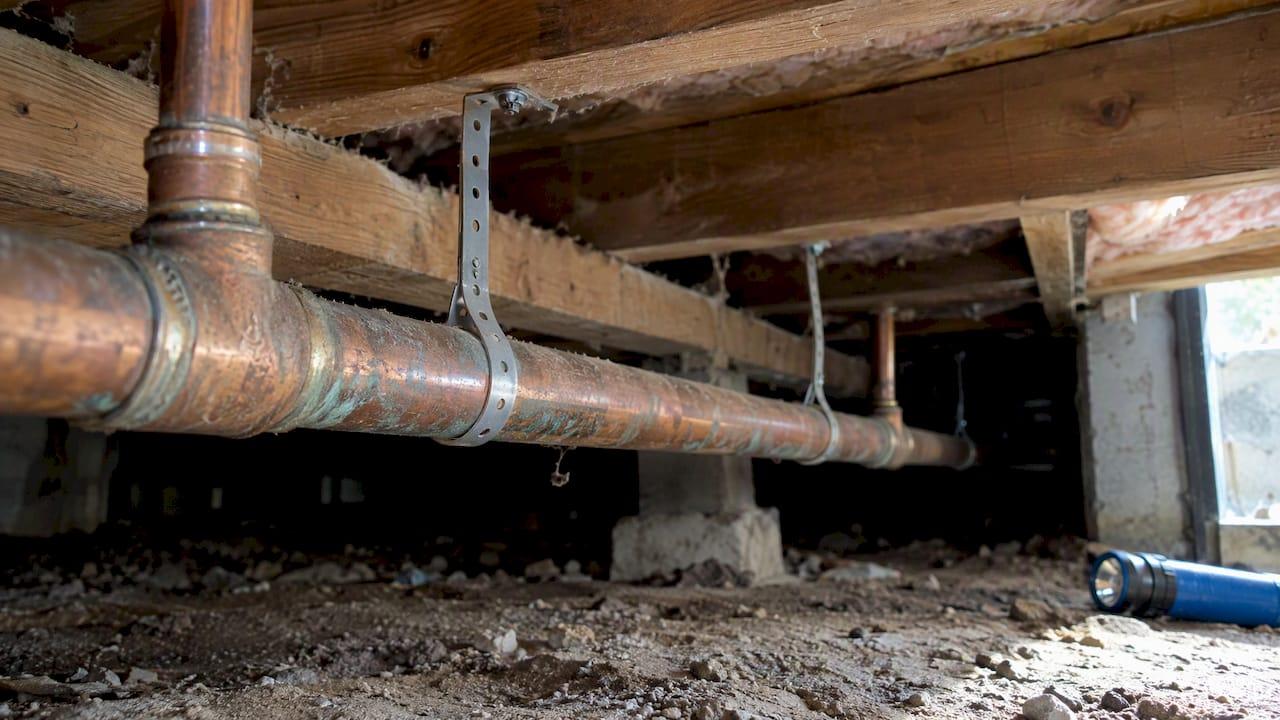
Copper pipe commonly lasts 50 to 70 years in a home, and well-installed lines in gentle water can last longer. Water chemistry, installation quality and flow conditions decide where your pipes land in that range. Galvanized steel pipe is a different story: it usually fails sooner and fails in ways you can see in your water.
This guide explains what drives copper's lifespan, how pinhole leaks start, how copper compares with galvanized pipe, and what replacement involves. We are a plumbing company in Rogers, AR, and we see all of this in local homes.
TL;DR
- Copper often lasts 50 to 70 years. Engineering research puts the ceiling near 100 years in nonaggressive water, while utilities use far more cautious design numbers.
- Water chemistry is the biggest variable. Pinhole leaks, green or blue stains and pressure changes are the main warning signs.
- One pinhole leak does not mean you need a whole-house repipe. Several leaks in different spots usually do.
- Galvanized pipe is the one to replace first. Homes with galvanized lines from the 1960s or earlier are likely near the end of their life.
- Replacing galvanized plumbing in a three-bathroom house has been reported at $6,000 to $10,000 for the plumbing work alone, before wall repairs.
Table of Contents
- How long copper pipe lasts
- What shortens or extends copper's life
- Warning signs your copper is failing
- Pinhole leaks in copper: what to do
- Galvanized vs. copper pipe
- When to replace: partial repair or repipe
- What galvanized replacement involves
- Cost to replace galvanized pipes
- Copper, PEX or something else
- Our perspective
- Get your pipes checked in Rogers, AR
- FAQ
- Sources
How long copper pipe lasts
The figure you will see most often is 50 to 70 years. That is a rule of thumb from the plumbing trade, and it fits what we see in homes with sound installation and ordinary municipal water.
The academic and utility numbers are more spread out. A peer-reviewed review of copper failure in potable water systems says copper potable water piping has a 100-year service life in nonaggressive water. The same paper notes that a conservative 20-year service life could be used for U.S. design purposes. WSSC Water, a large Maryland utility, takes a similar view in its copper pipe white paper: it treats 20 years as a conservative design assumption and says actual service life is usually 25 to 30 years or more in some U.S. areas.
Those numbers do not contradict each other. They describe different water, different installations and different levels of caution. Ohio's consumer counsel gives a broader range for all water line materials: water lines typically last 40 to 80 years, depending on the material.

So can copper last 150 years? Not as a promise. Individual pipes in very gentle conditions may outlast a century, but no one should plan on it. Plan on five decades, and watch for signs of trouble after that.
Copper lifespan at a glance
| Condition | What to expect |
|---|---|
| Gentle, well-treated water, careful installation | 50 to 70 years, sometimes much longer |
| Average municipal water, ordinary installation | Several decades, often 40 to 60 years |
| Aggressive water, high velocity or poor workmanship | Pitting can start in 20 to 30 years, sometimes sooner |
The third row reflects the utility and research figures above, not a guarantee. Your own pipes may do better or worse.
What shortens or extends copper's life
Copper does not wear out evenly, like a tire. It fails at weak points. WSSC's paper lists the main drivers: water chemistry and treatment, installation and workmanship, protective-film formation, and conditions that cause pitting corrosion.
Here is what that means in a house.
Water chemistry
Copper builds a thin protective film on the inside of the pipe. Water that is too acidic, too hard in the wrong way, or high in certain minerals can prevent that film from forming or can eat through it. This is the most common reason one house has leaks at 25 years while its neighbor is fine at 60.
If you are on a private well, test the water. Well water often differs sharply from city water, and a pH problem can eat copper from the inside.
Installation quality
Poor joints, rough pipe ends, leftover flux and bad support all cause trouble. This Old House notes that pinhole leaks can result from excess flux residue, high water velocity, improper pipe preparation, iron deposits, stagnant water or water chemistry issues. Most of those are installation problems, not material problems. A pipe that is cut square, reamed, cleaned and soldered correctly lasts longer than one that was rushed.
Flow and velocity
Water moving too fast, often from oversized pumps or very high pressure, wears the pipe wall at elbows and tees. Dead-end runs where water sits do the opposite: stagnant water breeds conditions that pit the pipe. A pressure regulator set correctly helps the first problem. Removing unused dead legs helps the second.
Age of the home
A copper system from the 1970s or 1980s is now past the 40-year mark. That does not mean it is failing. It does mean you should know where the pipes run, what the water does to them and where you would shut it off.
Warning signs your copper is failing
Copper thins from the inside out, so the early signs are easy to miss. Watch for these:
- Pinhole leaks. Tiny sprays or damp spots, often found in a wall or under a sink. They are the most common copper failure.
- Green or blue-green stains on pipes, fittings or nearby drywall. This is corrosion at a joint or a weeping spot.
- Bluish tint or metallic taste in water, which can mean copper is dissolving into it.
- Pressure drop that does not match what your utility reports.
- Unexplained water bills or a meter that moves when everything is off.
- Repeated repairs. Two or three leaks on different runs in a short time point to a system-wide problem.
If you suspect a hidden leak, our slab leak signs and meter test takes about two hours and tells you whether water is escaping while everything is off.
Pinhole leaks in copper: what to do
A pinhole leak is a tiny hole, often the size of a pin, where the pipe wall has worn through at a pit. They can spray fine water into a wall for weeks before anyone notices.

A county water department in Ohio is straightforward about the limits: homeowners cannot prevent pinhole leaks, but can limit damage by checking for leaks regularly and shutting off the main valve when away for an extended period. That is good practice for any house with aging pipes.
When you find one:
- Shut off the water to that line, or at the main valve.
- Dry the area and photograph the damage for your records.
- Call a licensed plumber to confirm the source. The wet spot is often not where the hole is.
- Ask what the rest of the line looks like. Cutting out a section and replacing it is a normal repair for one leak.
One pinhole does not condemn your whole system. The question is the pattern. A single leak at 35 years on a clean line is a repair. Three leaks in two years, on different runs, is a sign the pipe wall is thinning everywhere and that repiping will cost less than chasing leaks.
A burst or actively spraying line is a different situation. Our guide on what to do about a burst pipe covers the first 48 hours, and the burst pipe repair cost breakdown shows what to expect on the bill.
Galvanized vs. copper pipe
Galvanized steel pipe is steel coated in zinc. It was common in homes built before the 1960s. The zinc wears off over time, and the steel underneath rusts from the inside.
| Factor | Copper | Galvanized steel |
|---|---|---|
| Typical lifespan | 50 to 70 years, longer in good water | 40 to 100 years by one municipal estimate, but often much less in practice |
| How it fails | Pinhole leaks, pitting | Rust buildup, clogging, leaks as pipe rusts through |
| Water quality | Can leach copper in aggressive water | Rusty or discolored water as it corrodes |
| Pressure | Stays steady until a leak | Drops as the inside narrows |
| Replace when | Repeated pinholes across runs | Most galvanized pipe from before 1960s |
The lifespan range for galvanized comes from a city notice. It says galvanized pipes last 40 to 100 years and that pipes from the 1960s or earlier are likely nearing the end of their functional lifespan. The same notice describes how failure shows up: reduced pressure, uneven water distribution, discolored water and eventually leaks as the pipe rusts through.
The practical difference: copper tends to fail at a point, galvanized tends to fail along its length. A copper pinhole can be cut out. Galvanized that is rusting inside is rusting everywhere, and a patch just moves the weak point.
Lead is a second reason to look hard at older galvanized lines. Galvanized pipe can collect lead from upstream sources, and replacing lead-containing plumbing can reduce exposure. The University of Michigan's Graham Institute notes that the CDC has determined there is no safe level of lead in the blood. If your home has old galvanized lines and young children or a pregnancy in the house, talk to your doctor and have your water tested.
When to replace: partial repair or repipe
Use these rules.
Repair and keep going when:
- You have one pinhole on a copper line that is otherwise clean inside.
- The leak traces to a bad joint, not pipe wall thinning.
- The system is under 40 years old and water chemistry is not a known problem.
Plan a repipe when:
- Pinholes are showing up on more than one run.
- You have galvanized pipe from before the 1960s.
- Water is rusty, pressure is falling, or both.
- A camera inspection or pipe sample shows heavy internal pitting or scale.
Replacing everything is the cleanest fix for galvanized. The Cape May City notice says replacing all galvanized pipes is the best option for removing rust and lead from the piping system. Partial replacement can work when one section is clearly separate, such as a new addition, but you are then joining new pipe to old steel, and the old steel keeps aging.
For copper, a plumber can often check the condition before you commit. A video camera inspection of the lines you can reach, and a look at cut sections of removed pipe, show how thin the walls are inside.
What galvanized replacement involves
The process is the same whatever the material. The Cape May City guide lists the steps: inspect the plumbing, select replacement materials, protect the home, locate and remove the old pipes, and install the new ones.
In practice:
- Inspection and plan. The plumber maps the lines, fixture count and access points.
- Material choice. Copper, PEX or another approved material, discussed below.
- Protection. Floors and furniture are covered, and access holes are planned.
- Removal and install. New lines go in, are pressure tested and tied to the fixtures.
- Repairs. Drywall patching and paint, often handled by a separate trade.
Most jobs take a few days for an average home, depending on size and access. Water is off for part of each day, so plan where you will wash and cook.
Cost to replace galvanized pipes
Cost depends on the house, not just the pipe. The best published U.S. figure we found is from The Seattle Times, which reported in August 2021 that replacing all galvanized plumbing in a three-bathroom house commonly cost $6,000 to $10,000 for the plumbing work, including cutting into wall or ceiling surfaces to reach the pipes. That is a 2021 figure from one metro area, so treat it as a starting point and not a quote for Arkansas today.
The same article names the main cost drivers:
- Access. Upstairs bathrooms may require removing the ceiling below.
- Tile. A tiled tub or shower may require opening an adjoining wall.
- Wall type. Plaster repairs generally cost more than drywall repairs.
Other things that change the number: how many bathrooms and fixtures you have, whether the house is on a slab or crawlspace, and whether you want copper or PEX. Copper costs more in materials and labor than PEX. Our own breakdown of whole house repipe cost in Rogers walks through local factors.
The honest way to get a number is an on-site look. Anyone who quotes a whole-house price over the phone without seeing the house is guessing.
Copper, PEX or something else
Copper is no longer the default for new homes. HUD's research arm says PEX use in residential construction grew because of its performance and lower material and installation costs than copper. PEX installs faster and often uses continuous runs with fewer fittings. Fewer fittings means fewer places to leak. HUD also lists PVC and CPVC among the other materials used in homes.
That does not make copper a bad choice. Copper resists heat, does not degrade in sunlight, and has a long track record. PEX is cheaper and handles freeze expansion better, but should not be exposed to UV. For drainage and underground lines, the choice is different again; if you are weighing plastic options outside the house, comparing PVC and corrugated pipe shows how service life and practical limits differ by material.
How to choose:
- Copper if you want a metal system, have a high-end home or want a long track record.
- PEX if cost, speed and fewer wall openings matter most.
- Mixed systems when part of the house is in good shape and a transition is simple.
Whatever you pick, installation quality counts as much as material. A well-installed PEX line outlasts a sloppy copper job.
Our perspective
We get the call after the wall is already wet. That shapes how we think about pipe age.
First, a pipe's age matters less than what the water did to it. We would rather inspect a 45-year copper system with a camera than tell a homeowner to repipe based on a calendar. Many copper lines are fine at 50. Some are not fine at 25.
Second, patching the third leak in a galvanized house is poor value. If rust is coming through the faucet, the pipe is failing inside. Fixing a spot repair after spot repair costs more over time than one planned repipe, and the repipe is scheduled, not an emergency.
Third, clear pricing matters. We tell customers what we see, what it will take and what it will cost before work starts. A repipe is a large job and you should not be surprised by it.
Fourth, we limit disruption where we can. That means video inspection to see what is happening before cutting, and careful access planning so we open as little wall as the job needs.
— Jonathan
Get your pipes checked in Rogers, AR
If you have pinhole leaks, rusty water, falling pressure or galvanized pipe, we can inspect the system and tell you plainly whether it needs a repair or a repipe. Our licensed technicians handle whole house repiping, leak detection and plumbing video camera inspection across Rogers and the surrounding area. For an active leak, use our emergency plumbing repairs page.

Call or book online, and we will schedule a look at your lines.
FAQ
How often should you replace copper pipes?
There is no fixed date. Most copper systems last 50 to 70 years, and many are never fully replaced. Replace when pinholes appear on several runs, when inspection shows heavy internal pitting, or when water quality problems cannot be fixed another way.
Why do plumbers not use copper as much anymore?
Cost and speed. PEX has lower material and installation costs and uses fewer fittings, according to HUD research. Copper is still used where builders or owners want metal pipe.
What lasts longer, copper or PEX?
Copper has the longer track record, often 50 years or more. PEX is newer, so its record is shorter, but it avoids the pinhole corrosion that hits copper in aggressive water. Installation quality and water conditions affect both.
Should I replace galvanized pipes with copper?
Copper is a good, durable replacement, though PEX is also common and costs less. The bigger decision is to replace all the galvanized, not part of it. We can walk through the options for your house.
Can a pinhole leak in copper be fixed without repiping?
Yes. A plumber can cut out the damaged section and splice in new pipe. If leaks keep appearing on different runs, the whole system is usually thinning and repiping makes more sense.
Sources
- Flow-induced failure mechanisms of copper pipe in potable water systems (Corrosion Reviews)
- Copper Pipe White Paper (WSSC Water)
- What to Know About Utility Line Warranties (Ohio Consumers' Counsel)
- How To Stop Copper Pipe Corrosion (This Old House)
- Pinhole leaks (Butler County, Ohio Water and Sewer)
- Why You Need To Swap Out Your Galvanized Pipes (Cape May City)
- Michigan's Revised Lead and Copper Rule FAQ (Graham Institute)
- Do I really need to replace all of my galvanized pipes? (The Seattle Times)
- Water Piping in the Home (HUD USER)