
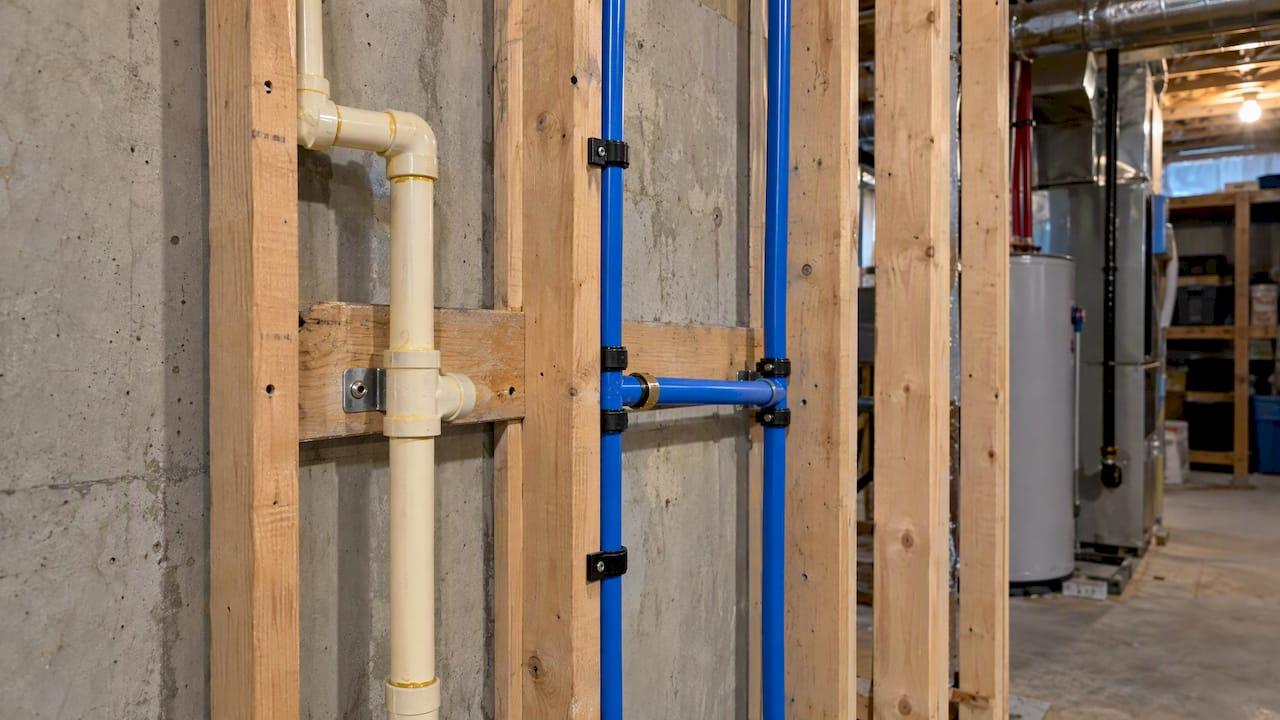
CPVC is rigid, glued plastic pipe that handles heat and strong disinfectants well. PEX is flexible tubing that bends around corners and tolerates freezing better. Both are approved for hot and cold drinking water. Neither is better in every house. The right choice depends on the layout, the water supply, the climate and whether you are repairing, repiping or building new.
Below we compare them on the points that matter in a real job: cost, install time, temperature and pressure ratings, chlorine, freezing, joints, code and repairs.
TL;DR
- CPVC is usually the cheaper material. Install time depends on layout: CPVC was about 15% faster in trunk-and-branch systems, PEX about 10% faster with manifolds.
- PEX flexes, so it handles freezing and tight routes better. CPVC resists chlorine, chloramines and chlorine dioxide better, and handles sunlight better.
- Both are approved in the major model plumbing codes. Your local inspector and the manufacturer's instructions decide the details.
- Chemicals matter for both. Spray foam, cleaners and sealants can damage CPVC. Thread sealants, solder flux and petroleum products can damage PEX.
- For a whole house repipe, the best pipe is the one that fits your walls, your water and your budget. A licensed plumber should look at the house first.
Table of Contents
- The short answer on CPVC vs PEX
- What each pipe is
- Side-by-side comparison
- Cost and installation time
- Joining methods and installation
- Temperature, pressure and flow
- Chlorine, chemicals and sunlight
- Freezing and Arkansas winters
- Building codes
- Which pipe for which job
- Common mistakes
- Our perspective
- Work with JoCo Plumbing in Rogers
- FAQ
- Sources
The short answer on CPVC vs PEX
Choose CPVC when you want a rigid, proven system with straight runs, exposure to high chlorine levels, or a lower material price. Choose PEX when you need to snake pipe through finished walls, want fewer fittings, or worry about freezing.
Most homeowners in Northwest Arkansas never choose between them on paper. The plumber does, after seeing the attic, crawl space, slab and water source. That is the right order. The comparison below lets you ask better questions when they do.
What each pipe is
CPVC
CPVC is chlorinated polyvinyl chloride. It is a rigid, cream or light yellow plastic pipe joined with solvent cement. It looks like PVC but is rated for much higher temperatures. It is cut with a tubing cutter or saw, cleaned and glued into socket fittings.
PEX
PEX is cross-linked polyethylene. It comes in coils and straight lengths, in red, blue and white. It is flexible. Joints are made with mechanical fittings: crimp rings, stainless cinch clamps, expansion rings or push-to-connect fittings. PEX is sold in types (often labeled A, B and C) that describe how it is made. Each type works. The differences are in flexibility and fitting method.
Side-by-side comparison
| Factor | CPVC | PEX |
|---|---|---|
| Rigidity | Rigid, limited deflection | Flexible, bends around obstacles |
| Joining | Solvent cement in socket fittings | Crimp, cinch, expansion or push-fit fittings |
| Material cost | Generally lower | Generally higher |
| Temperature rating | Up to 200°F | 100 psi at 180°F |
| Chlorine resistance | High, including chlorine dioxide | Good to 4.0 ppm chlorine and chloramines, sensitive to chlorine dioxide |
| Sunlight | Better UV tolerance | Must be shielded from UV |
| Freezing | Can crack | Expands more before failing |
| Maximum design velocity | 8 ft/s for tubing | 10 ft/s cold, 8 ft/s hot |
| Fittings pressure loss | Socket fittings, less loss | Insert fittings narrow the bore |
The ratings in the table come from Plastics Pipe Institute materials and its commercial plumbing presentation. The rest of this article explains what they mean for a house.
Cost and installation time
The American Society of Plumbing Engineers reports that CTS SDR 11 CPVC is generally less expensive than PEX. Time is more mixed. In its comparison, CPVC was about 15% faster in trunk-and-branch installations, where one main line feeds branches to each fixture. PEX was about 10% faster in mini-manifold installations. The extra manifold material cost offset the time savings.

That tells you something useful: PEX is not automatically the fast option. A simple one-story layout with short straight runs favors CPVC. A two-story house with long, awkward runs, or a remodel where you must fish pipe through closed walls, favors PEX.
Labor and material are only part of the bill. Drywall repair, permits, water shut-off time and fixture work often cost as much as the pipe. For Rogers-area ballparks on the full job, see our guide to whole house repipe cost.
Joining methods and installation
How CPVC is joined
CPVC is cut square, deburred, and wiped clean. Solvent cement is applied to the pipe and the fitting socket, and the pieces are pushed together and held briefly. The cement welds the plastic. Use cement made for CPVC. Standard PVC cement is not suitable for CPVC's higher temperature rating. Cold weather and dirty pipe ends need extra care, so installers follow the cement manufacturer's instructions on temperature and cure time before pressure testing.

Glued joints are quick and cheap, but they are permanent. Fixing a mistake means cutting out the joint and adding couplings.
How PEX is joined
PEX connections are mechanical. The installer slides a copper crimp ring or stainless cinch clamp over the pipe and fitting, then compresses it with a tool. Expansion systems stretch the pipe end, insert the fitting, and let the pipe shrink back. Push-to-connect fittings need no tool but cost more per joint. Each system needs its own matched tool and fittings. Mixing brands is a common cause of leaks.
PEX also uses fewer fittings, because it bends instead of needing a 90-degree elbow at every turn. Fewer joints means fewer places to leak. But the insert fittings used with most PEX reduce the inside diameter at each connection. ASPE notes that this causes a higher pressure drop than socket fittings, so designers sometimes upsize the pipe.
Support and expansion
Both plastics need support. The Arkansas plumbing code lists maximum spacing: CPVC up to 1 inch needs support every 3 feet horizontally, PEX up to 1 inch every 32 inches. Always confirm the edition and any local amendment in force with your inspector.
CPVC expands and contracts noticeably with temperature changes. The Plastics Pipe Institute says it can deflect around objects, but thermal expansion must be designed for. That means offsets, loops or proper hanger spacing on long hot water runs.
Temperature, pressure and flow
Both pipes work for hot and cold water in houses. CPVC systems are rated up to 200°F. SDR 11 CPVC tubing is rated 400 psi at 73°F and 100 psi at 180°F, according to the PPI code presentation. PEX is rated 160 psi at 73°F and 100 psi at 180°F.
In a house with 60 to 80 psi city pressure and a water heater set at 120°F, both pipes have a wide margin. The ratings matter more when you have a booster pump, a recirculation loop or a high-temperature boiler tie-in. If your pressure runs high, a regulator protects every pipe and fixture. See water pressure regulator costs.
PPI also lists maximum design velocities. For CPVC tubing it is 8 feet per second. For PEX it is 10 feet per second cold and 8 feet per second hot. Fast water in undersized pipe causes noise and wear. That is one reason line sizing matters as much as material.
If you are sizing lines and thinking about fitting losses, the same pressure-drop logic applies when you plan heat for an addition. This comparison of underfloor heating versus radiators walks through that decision.
Chlorine, chemicals and sunlight
City water in Arkansas is disinfected, and the disinfectant type affects your pipe. According to PPI, CPVC resists high levels of chlorine, chloramines and chlorine dioxide. PEX resists chlorine and chloramines up to 4.0 ppm, is sensitive to chlorine dioxide, and can be damaged by too much UV.
The PEX material code on the pipe indicates its chlorine and UV ratings. Read the printed markings. Do not leave PEX in sunlight on a job site for months before it is covered.
Chemical contact is the quiet failure cause for both pipes:
- CPVC: certain caulks, cleaners, sealants, firestop materials and spray foam can damage it.
- PEX: thread-sealing compounds, solder flux, petroleum-based products and some firestop compounds can damage it.
This matters in remodels. A spray-foam crew or a plumber using the wrong sealant on a nearby threaded joint can harm a pipe that was installed correctly. Tell every trade what is in the wall.
If you treat your water, say with a softener or whole-house filtration, check the pipe manufacturer's warranty terms for the treatment method. Our water treatment services page lists what we install.
Freezing and Arkansas winters
Northwest Arkansas gets hard freezes, and pipes in garages, exterior walls and vented crawl spaces are at risk. PEX is the better choice here. It stretches as water freezes and is more likely to survive a freeze. It is not freeze-proof. Fittings can still split, and a frozen line can still burst.
Rigid CPVC is more brittle in the cold and can crack when ice forms. If CPVC runs through unheated space, insulate it, seal air leaks, and know where your main shut-off is. If a pipe does burst, our guides on what to do when a pipe bursts and burst pipe repair cost cover the first steps and what the repair costs.
Building codes
Both materials are approved in the model codes, including the International Residential Code, International Plumbing Code and Uniform Plumbing Code, per the PPI. Approval in a model code does not settle your job. Arkansas adopts its own plumbing code, and cities can add rules. Fittings must be listed for the pipe, and permits and inspections apply to repiping.
A licensed plumber pulls the permit and builds to the code in force. Ask who is doing that before you sign.
Which pipe for which job
Whole house repipe
In a repipe, the walls decide. A single-story house with an open attic and accessible crawl space can suit either pipe. A two-story house with finished walls usually favors PEX because the pipe can be pulled through with less drywall damage. If your water has high chlorine dioxide or you have older piping with a long run, CPVC may be the better choice. Ask for the reasoning, not just the material.
Single repair
Match what is already there. Joining CPVC to PEX is possible with transition fittings made for the purpose: a solvent socket on the CPVC side and a mechanical connection on the PEX side. Do not improvise with fittings not rated for both.
Remodels
Kitchen and bathroom remodels often move supply lines. PEX is easier to extend to a new sink or shower in a tight wall. CPVC is neat and economical when walls are open and runs are straight.
Hot water recirculation and tankless heaters
Both work. Check the water heater manufacturer's pipe and temperature requirements, and keep to the pressure ratings above.
Commercial buildings
Larger buildings add velocity limits, fire-rated assemblies and expansion design. Both materials are used, and the design is engineered job by job.
Common mistakes
- Mixing fitting systems. PEX crimp, cinch and expansion parts are not interchangeable.
- Using PVC cement on CPVC. It is not rated for the temperature.
- Skipping expansion allowances on CPVC. Long hot runs need room to move.
- Leaving PEX in the sun. UV weakens it.
- Letting other trades damage the pipe. Spray foam and sealants can harm CPVC. Flux and petroleum products can harm PEX.
- Undersizing PEX. Insert fittings reduce the bore. Size for the fittings.
- Ignoring unheated spaces. Insulate whichever pipe you choose.
Our perspective
We see this question most when a homeowner has had a leak and is thinking about replacing the whole system. Our answer starts with the house, not the pipe. We look at how the water enters, where the walls are open, what the water heater needs, and where the pipes run through cold space.
We use a licensed technician for the job, pull what is needed for permits, and explain the choice in plain terms. If the existing line is the problem, we use a plumbing video camera inspection or leak detection before recommending a full replacement. Often a targeted repair solves it. When a repipe is the right call, we want you to know why one material fits your house better than the other.
Price should be clear before work starts. Pipe choice changes labor and material, and you should see how.
— Jonathan
Work with JoCo Plumbing in Rogers
We repipe homes, repair water lines, find hidden leaks and respond to plumbing emergencies in Rogers and the surrounding area. If you are comparing pipe materials for a repipe, we will look at the house and explain the options. See our whole house repiping service, or contact JoCo Plumbing to book an assessment.

If the problem is a leak you cannot find, start with leak detection and repair. If it is a buried supply line, see our main water line repairs.
FAQ
Is PEX or CPVC better for a whole house repipe?
Neither wins everywhere. PEX is usually easier in finished multi-story homes because it bends through walls. CPVC suits open, straight layouts and is generally the cheaper material. A plumber should inspect your walls and water before choosing.
Can you connect CPVC to PEX?
Yes, with a transition fitting made for it. One end is a CPVC solvent socket and the other is a mechanical PEX connection such as a crimp, cinch or push-fit. Use CPVC cement, not PVC cement, on the CPVC side.
Which pipe handles freezing better?
PEX. It expands more than rigid CPVC and is less likely to split when water freezes. It can still fail, so insulate pipes in garages, exterior walls and vented crawl spaces.
Does chlorine in city water damage PEX or CPVC?
At typical levels, PEX resists chlorine and chloramines up to 4.0 ppm. It is sensitive to chlorine dioxide. CPVC resists all three at high levels. Check your utility's water quality report and the PEX markings.
Are both pipes allowed by code?
Both are listed in the major model codes. Arkansas and your city set the rules that apply, so confirm with your plumber and the local building department.
Sources
- PPI: Plastic pipe presentation for ICC 815 (2023)
- PPI: Selecting Optimal Pressure Pipe for Commercial Plumbing
- PPI TN-62: Suitability and Fitness of CPVC Piping
- ASPE: Choosing Plumbing Systems for Residential Construction Projects
- 2018 Arkansas Plumbing Code, Chapter 3
- How to Connect PEX to CPVC
- Underfloor heating vs radiators