
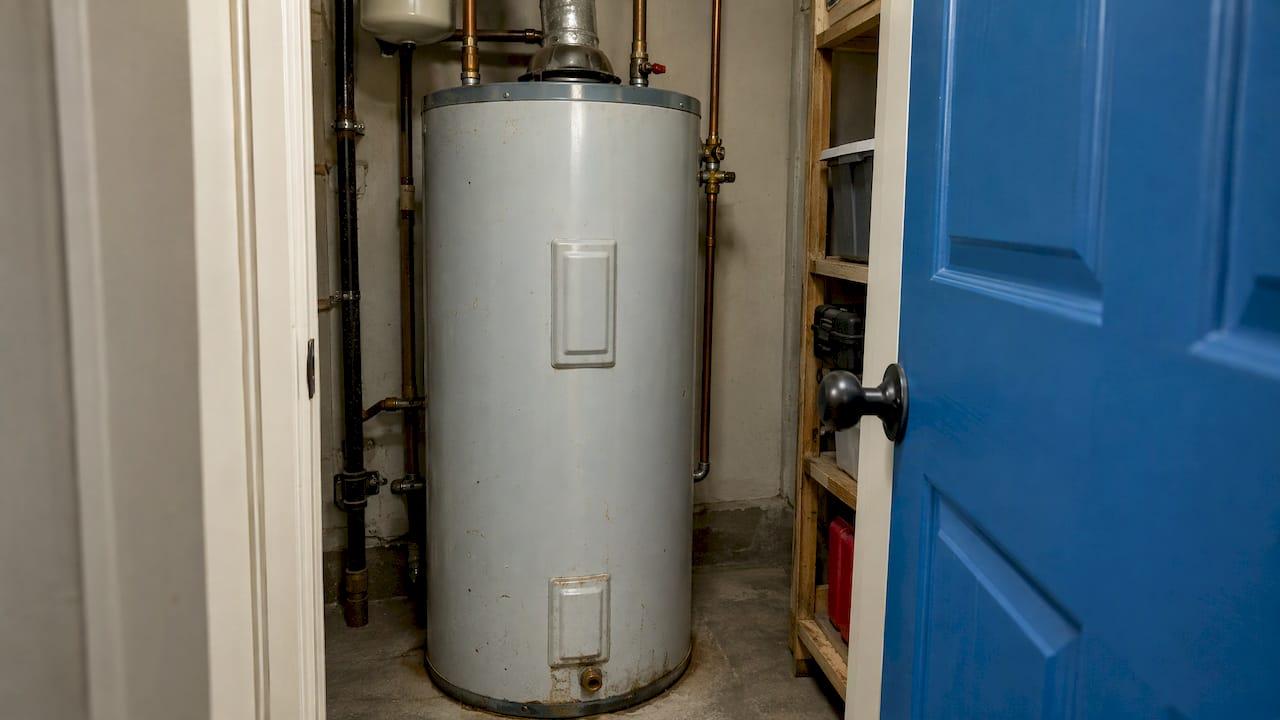
Most tank water heaters last about 8 to 12 years. Tankless models typically last 15 to 20 years with proper care. Your unit may land above or below that range, depending on installation quality, water quality, maintenance and where it sits in your home. Once a tank passes 10 years, or starts leaking, rumbling or running out of hot water, it is time to plan the replacement before it plans itself.
This guide covers what the numbers mean, what shortens a heater's life, how to read your unit's age, and how to decide between a repair and a new unit.
TL;DR
- Tank water heaters usually last 8 to 12 years. Tankless units usually last 15 to 20 years.
- Water quality, installation, sediment and the anode rod have the biggest effect on how long a unit lasts.
- Leaks, rust in the water, rumbling noises, corrosion and a lack of hot water are the main warning signs.
- A tank over 10 years old that needs repairs is usually a replacement candidate. A leak at the tank base is an emergency.
- You can read the age from the serial number on the label. Do it before the heater fails, not after.
Table of Contents
- How long water heaters last, by type
- What shortens or extends the life of a water heater
- Tankless water heater lifespan
- Signs your water heater is failing
- How to find out how old your water heater is
- Repair or replace: a simple way to decide
- Maintenance that helps a water heater last
- Our perspective
- Buying or selling a home with an older heater
- Schedule a water heater check or replacement in Rogers
- FAQ
- Sources
How long water heaters last, by type
The short answer depends on the kind of heater you own. The figures below come from manufacturers, a city water bureau and a home inspector association. They agree closely.
| Heater type | Typical lifespan | Source |
|---|---|---|
| Tank (gas or electric) | 8 to 12 years | A. O. Smith |
| Tank, general rule of thumb | About 10 years | InterNACHI |
| Tankless | 15 to 20 years with proper care | A. O. Smith |
| Tankless, well maintained | Up to 25 to 30 years | Rheem |
Portland's water bureau gives 10 years for a tank-style heater and 20 years for a tankless heater as the typical figures. That matches the middle of the manufacturer ranges.
Treat these as averages, not a countdown. A tank in a home with gentle water and regular care can go well past 12 years. A tank in a home with heavy mineral content and no maintenance can fail earlier.
What shortens or extends the life of a water heater
A. O. Smith says average life expectancy varies with the location and design of the unit, installation quality, maintenance schedule and water quality. InterNACHI adds usage volume and construction quality to that list. Here is how each factor plays out.
Water quality and sediment
Minerals in the water settle at the bottom of a tank and coat heating surfaces. InterNACHI notes that in areas with higher mineral content, water heaters have shorter lifespans, because buildup reduces efficiency, and periodic flushing can counteract this.
Energy Vanguard explains the failure path. Without maintenance, dissolved minerals eat away at the glass lining and then the steel tank, killing the tank in about 9 to 12 years. A sacrificial anode rod draws corrosive particles away from the tank, and regular draining keeps sediment from piling up.
If your home has hard water, a softener protects more than your fixtures. It also reduces what reaches the heater. We install water softeners and filtration systems for homes in Rogers and nearby areas.
The anode rod
The anode rod is the part that corrodes so the tank does not. A. O. Smith's maintenance checklist says to check it at least every three years, and annually if you have a water softener. A spent rod is one of the cheapest things to catch early and one of the most expensive to miss.
Water pressure
The same checklist advises checking water pressure and installing a pressure reducing valve if pressure exceeds 80 psi. High pressure stresses the tank, the fittings and every fixture in the house. It is a common hidden cause of early failure.
Installation quality
A heater installed with poor venting, wrong sizing or bad connections wears out faster. This matters most for tankless units. A. O. Smith lists hard water deposits, heat exchanger leaks, excessive water pressure, undersized systems, electrical or ignition problems and ventilation issues as the main reasons tankless heaters fail. Several of those are installation issues, not product defects.
Temperature setting and use
Family Handyman suggests checking the temperature setting once a year, with a target of 120 to 130 degrees, and looking for leaks at the same time. A household that draws a lot of hot water from a small tank asks more of it every day.
Tankless water heater lifespan
Tankless heaters last longer because there is no storage tank to corrode. A. O. Smith puts them at 15 to 20 years with proper care, nearly double the 8 to 12 years of a traditional tank. Rheem says well-maintained tankless systems can reach 25 to 30 years.

The key phrase is "with proper care." Rheem notes that for tankless systems, annual flushing or descaling clears mineral buildup from the heat exchanger, especially in hard water areas. A home inspector writing on Inspectapedia also points out that installation errors, site conditions and water or gas pressure variations can cut a tankless unit's life short. The long lifespan comes from a correct install plus yearly service.
If you are weighing the two types, our guide to tankless vs tank water heaters compares them for a typical home. For cost, see our breakdown of what an itemized tankless quote includes.
Signs your water heater is failing
ENERGY STAR lists the common red flags: visible corrosion, water leaking, rust in the water, a lack of hot water and rumbling noises. Here is what each one tells you.
- Leaks at the tank. Water pooling at the base usually means the tank itself has failed. A tank leak does not get better. Shut off the water supply to the heater, shut off power or gas, and call a plumber. Our guide on what to do when a water heater leaks walks through it.
- Rust-colored water. Portland.gov says rust-colored water or a leaking tank indicates the sacrificial anode no longer works, which can lead to tank corrosion or failure.
- Rumbling or popping. Sediment at the bottom traps water, which boils and makes noise. It means buildup is already insulating the water from the burner or element.
- Not enough hot water. Short showers, lukewarm water or inconsistent temperature point to sediment, a failing element or burner, or a tank that is wearing out. If you are seeing this, our five checks for a water heater not heating will help you narrow it down.
- White plastic particles. Portland.gov notes these indicate the plastic dip tube is breaking down inside the tank.
- Visible corrosion on the tank, fittings or connections.
- Age. ENERGY STAR says that if you suspect your unit is more than 10 years old, consider replacing it.
If you smell gas near a gas-fired heater, leave the house and call your gas utility or 911 from outside. Do not troubleshoot it. Our page on gas leak signs explains what to smell, hear and see.
How to find out how old your water heater is
You do not need paperwork. ENERGY STAR says to find the brand name and serial number, because the manufacture date may be on the tank label, or an online industry resource can decode the serial number.
The steps are simple:
- Find the rating label on the side of the tank, usually near the top.
- Write down the brand, model and serial number.
- Look up the brand's serial number format. Many brands encode the month and year in the first few characters.
- If the label is unreadable, look for an installation date on a tag or in your records.
The Texas Office of Public Insurance Counsel gives the same advice: if you do not know the age, look for a label with an installation date or research the manufacturer and serial number online. It also says typical heaters last 8 to 12 years, and an older unit that keeps going out may be due for replacement.
The manufacture date is not always the install date. A tank can sit in a warehouse for months. Count from the manufacture date to be safe.
Repair or replace: a simple way to decide
Use three questions.
How old is it? ENERGY STAR's factsheet says that at 10 years or older, a heater is more likely to heat water inconsistently or fail altogether. A. O. Smith agrees: if the unit is more than 10 years old, leaks around the base, or operates erratically, it is probably time to replace it.
How often has it needed repair? Washington Gas, citing ENERGY STAR, says that if you are calling for repairs more than twice a year, start planning for a new heater.
What does the repair cost against a new unit? Rheem's guide says replacement is almost always the better investment when repairs cost more than 50% of a new unit, or when you have needed several repairs in a short time.
| Situation | Usual call |
|---|---|
| Under 8 years old, minor issue (thermostat, element, valve) | Repair |
| 8 to 10 years old, one repair needed | Repair, and start budgeting |
| Over 10 years old, repeated repairs | Replace |
| Leak from the tank body | Replace |
| Rust in hot water and a spent anode | Replace, or inspect first if the unit is young |
For a sense of what a new unit costs, see our water heater replacement cost guide and quote checklist. It shows what a complete quote should list, so you can compare line by line.
Maintenance that helps a water heater last
Maintenance will not make a worn-out tank last forever, but it removes the causes of early failure. A. O. Smith's checklist covers the core tasks:
- Drain and flush the tank.
- Check water pressure, and install a pressure reducing valve if it is above 80 psi.
- Check the anode rod every three years, or every year with a softener.
- Test the temperature and pressure (T&P) relief valve.
Family Handyman recommends a professional inspection of the anode rod and venting system. It also carries a useful caution. An expert it quotes says that if you have never flushed your heater, or have not in the last two years, now may not be the best time to start. Old sediment may be sealing small corrosion spots, and disturbing it can start a leak. If your heater is old and has never been serviced, have a plumber look at it first.
For tankless units, schedule descaling once a year. In hard water areas, do not skip it.
Our perspective
We see the same pattern on service calls. Most water heater failures do not come out of nowhere. The heater was 11 or 12 years old, the owner noticed a little rust or a rumble, and nobody looked at it until water was on the floor.
Our advice is to know your unit's age today. Read the label, write the date down, and set a reminder for year 8. At that point, have a licensed plumber check the anode rod, pressure and venting. That visit costs far less than a flooded utility room.
When replacement is the right call, we prefer to plan it. A planned replacement lets you choose between a tank and a tankless unit, compare itemized quotes and schedule the work. We offer both tank and tankless installation, and we also handle the related work that protects the new unit, such as water softeners and pressure issues.
Emergency calls are part of our work too. But the best water heater job is the one you booked on your own terms.
Jonathan
Buying or selling a home with an older heater
A water heater near the end of its life matters when a house changes hands. Buyers should have the heater's age and condition checked during the inspection, and ask for a plumbing video inspection of the lines if the home is older. Sellers who know a unit is near 10 years can replace it before listing, which removes a negotiating point.
Aging plumbing is wider than the heater. If you are dealing with older supply pipes, see this explanation of selling a house with polybutylene pipes and the options it gives owners.
Schedule a water heater check or replacement in Rogers
If your heater is past 8 years, leaking, rusting or running out of hot water, we can inspect it and give you a clear recommendation. We install and replace both tank and tankless water heaters for homes and businesses in Rogers, AR and surrounding areas. We are licensed, and we work to explain pricing before the job starts.

See our water heater replacement and installation and tankless water heater installation pages, or contact JoCo Plumbing to book. If water is already leaking, use our emergency plumbing repairs line and call now.
FAQ
How long do water heaters last?
A tank water heater typically lasts 8 to 12 years. A tankless heater typically lasts 15 to 20 years with proper care. Water quality, installation, maintenance and usage all move those numbers up or down.
When should I replace my water heater?
Consider replacement when a tank is more than 10 years old, leaks, shows rust in the water, or needs repeated repairs. If repairs would cost more than half the price of a new unit, replacement is usually the better investment. A leak from the tank body means replacement, not repair.
Can a water heater last 20 years?
Some do, but it is not the norm for a tank. Regular flushing and anode rod replacement help, and Energy Vanguard describes how a maintained tank can last more than 15 years. Tankless units are far more likely to reach 20 years.
Does a water softener extend water heater life?
Hard water leaves mineral deposits that shorten the life of both tank and tankless units, so reducing the minerals reaching the heater helps. A. O. Smith says to check the anode rod annually when a softener is installed, because softened water can use it up faster.
Is it worth repairing a 10-year-old water heater?
Usually only for a cheap, one-time fix. At 10 years, ENERGY STAR advises considering replacement, and a unit that keeps needing repairs is not a good place to spend more money.
Sources
- When to Repair or Replace Your Water Heater, A. O. Smith
- How Long Do Tankless Water Heaters Last, A. O. Smith
- Annual Water Heater Maintenance Checklist, A. O. Smith
- Estimating the Lifespan of a Water Heater, InterNACHI
- Maintaining your water heater, Portland.gov
- When Should You Replace Your Water Heater, ENERGY STAR
- Electric water heater factsheet, ENERGY STAR
- Tank vs. Tankless Water Heater Lifespan Comparison, Rheem
- Water Heater Lifespan: When to Repair vs. Replace, Rheem
- Tankless water heater life, Inspectapedia
- Can a Water Heater Last More Than 15 Years, Energy Vanguard
- Why You Should Be Flushing Your Water Heater, Family Handyman
- Preventing Damage from Water Heaters, OPIC
- Five Signs It May Be Time to Replace Your Water Heater, Washington Gas
- Selling a House With Polybutylene Pipes