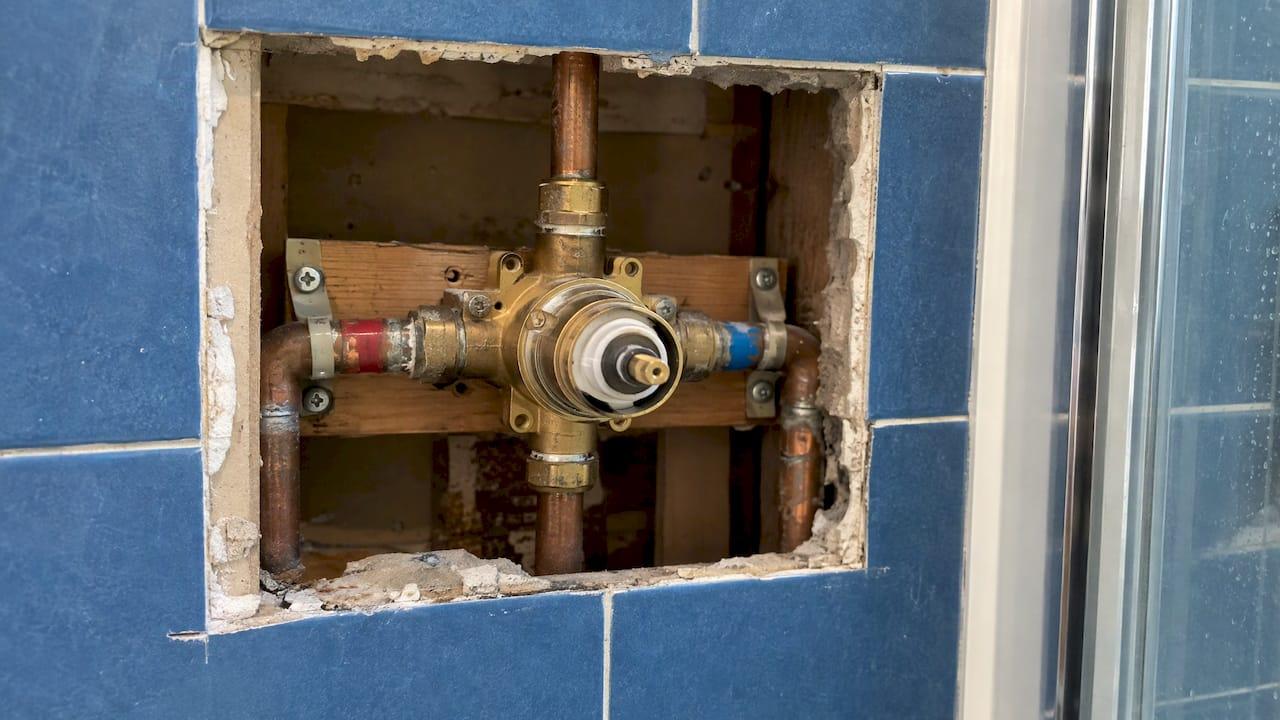
Most homes use one of five shower valve types: pressure-balancing, thermostatic, mixing, diverter or transfer. Pressure-balancing is the most common. Thermostatic valves hold temperature more precisely and cost more. Diverter and transfer valves do not control temperature at all. They only decide where the water goes. Below, we explain what each valve does, how to tell them apart, when to replace one and what the job usually costs.
TL;DR
- Pressure-balancing valves are the standard choice. They use one handle and keep temperature steady within a few degrees when water pressure shifts.
- Thermostatic valves sense the actual water temperature. They usually cost more and suit users who want a set temperature or several shower outlets.
- Diverter and transfer valves direct water to the tub spout, shower head or several outlets. They are separate from the valve that mixes hot and cold.
- A typical shower valve replacement runs a few hundred dollars. Access to the valve body drives the price.
- If you have a tankless water heater, tell your plumber before choosing a valve.
Table of Contents
- What a shower valve does
- The main shower valve types
- Pressure-balancing vs. thermostatic: which to choose
- Choosing a valve if you have a tankless water heater
- How to identify the valve you already have
- When to replace a shower valve or cartridge
- What shower valve replacement costs
- Our perspective
- Plumbing help for your shower in Rogers, AR
- FAQ
- Sources
What a shower valve does
The shower valve sits inside the wall behind the handle. It mixes hot and cold water, sets the flow and, in some designs, protects you from sudden temperature swings. The handle, trim plate and shower head are the parts you see. The valve body and cartridge are the parts that wear out.
Two jobs often get confused. One is mixing and temperature control: the valve that blends hot and cold. The other is routing: sending water to a tub spout, a shower head or a body spray. Mixing valves, pressure-balancing valves and thermostatic valves handle the first job. Diverters and transfer valves handle the second. A shower can have both kinds.

The main shower valve types
Buying guides group valves a little differently. One retail guide lists five common types, and another lists six, including manual valves. The list below covers the types you will actually meet in a home.
| Valve type | What it does | Handles | Typical home |
|---|---|---|---|
| Pressure-balancing | Keeps the hot-to-cold ratio steady when pressure changes | Usually one | Most homes built or remodeled in recent decades |
| Thermostatic | Senses and holds the actual water temperature | Often two (volume and temperature) | Remodels, multi-outlet showers, accessibility needs |
| Mixing (manual) | Blends hot and cold with no compensation | One or two | Older homes |
| Diverter | Sends water to the tub spout or shower head | Lever, knob or handle | Tub and shower combinations |
| Transfer | Sends water to several outlets, sometimes at once | Separate control | Larger walk-in showers |
Pressure-balancing valves
This is the most common type. It is also called a mechanical or anti-scald valve. Inside, pistons or diaphragms move with changes in water pressure and keep the temperature within about 2 or 3 degrees Fahrenheit. If someone flushes a toilet or starts the dishwasher, the valve adjusts so you do not get a blast of cold or scalding water.
One handle controls both volume and temperature. Turn it further and you get more water. Rotate it toward hot and the water warms up. The simplicity is the appeal: fewer parts, a smaller valve body and an easy fit in most walls.
Thermostatic valves
A thermostatic valve works differently. It reacts to the temperature of the water itself, using a wax element that expands and contracts with heat. A pressure-balancing valve only controls the ratio of hot to cold. A thermostatic valve controls the result.
Typical thermostatic setups have two handles: one for volume and one for temperature. You can set the temperature once and turn the water on and off with the volume handle. That helps if you like to soap up with the water off and rinse at the same temperature. Thermostatic valves can also suit older users or care settings, since the temperature can be preset and left alone.
Thermostatic valves come in four common layouts, according to a home improvement retailer's valve guide:
- Twin thermostatic: one handle for temperature, one for flow, one outlet.
- Twin with a diverter: the same, plus a control to switch between outlets.
- Triple thermostatic: separate controls for temperature and for two outlets.
- Triple with a diverter: adds a switching control for more outlets.
There is also a hybrid. A thermostatic pressure-balanced valve combines both mechanisms in one cartridge, so it responds to temperature and pressure together.
Mixing valves
A basic mixing valve draws from the hot and cold supply and blends them. They are mostly found in older homes. With no compensation built in, the temperature can swing when pressure changes elsewhere in the house. If your shower runs cold when a toilet flushes, you may have this type. Upgrading to a pressure-balancing valve is a common fix.
Diverter valves
A diverter is the control that sends water between two outlets, usually the tub spout and the shower head. In a tub and shower combination, it is the pull-up knob on the spout or a lever on the wall. Diverters direct water to the shower head or the tub spout. They do not set the temperature.
If water still pours from the tub spout while the shower is running, the diverter is worn. That is a separate repair from the mixing cartridge. Sometimes only the spout needs replacing.

Transfer valves
A transfer valve moves water among several outlets: an overhead rain head, a handheld sprayer, body sprays. Some designs let multiple shower heads run at once, and they are typically found in larger walk-in showers. The difference from a diverter comes down to scale. A diverter picks between two outlets. A transfer valve manages several and can be set to run more than one together.
A multi-outlet shower needs enough supply to feed them. Pipe size and household pressure matter as much as the valve. If you plan body sprays, raise it with your plumber at the design stage.
Pressure-balancing vs. thermostatic: which to choose
Both give scald protection. The right choice depends on how you shower and how your bathroom is built.
| Factor | Pressure-balancing | Thermostatic |
|---|---|---|
| What it senses | Pressure of hot and cold supplies | Temperature of mixed water |
| Temperature stability | Within about 2 to 3°F | Typically within 1 or 2°F |
| Controls | Usually one handle | Often separate volume and temperature handles |
| Cost | Lower | Can run up to twice as much |
| Fit | Easier in tight walls and retrofits | Can be harder in small spaces |
| Best for | Standard showers, simple remodels | Multiple outlets, preset temperature, higher-end builds |
The temperature ranges above come from buying guides and vary by product. Check the specifications of the model you pick.
A few practical points:
- Budget and simplicity: pressure-balancing is the sensible default. It does what most households need.
- Several outlets or a set temperature: thermostatic gives you separate control of temperature and volume.
- Sudden flushes: a thermostatic valve responds to temperature, so its behavior during a sudden pressure drop can differ from a pressure-balanced cartridge. Ask about the specific model.
- Hard water: thermostatic elements can be affected by mineral buildup and scale. A water softener helps protect any valve and fixture in a hard-water home.
Code requirements
Building codes require scald protection at showers. The Uniform Plumbing Code requires individual pressure-balance, thermostatic or combination valves for showers and tub-shower combinations, with the maximum mixed-water setting at 120°F. Other model codes contain similar rules. Which code applies depends on your city or county, so ask your local building department. A licensed plumber will install a compliant valve and handle any permit.
Choosing a valve if you have a tankless water heater
Tankless heaters change the equation. Pressure-balanced valves are not always recommended with tankless heaters. The hot-water pressure out of a tankless unit can be lower than household cold-water pressure. A pressure-balancing valve then cuts flow to match the weaker side, and the shower feels weak.
That does not mean a tankless heater is a poor fit for your home. It means valve and heater should be chosen together. If you are planning a remodel and a new water heater at the same time, plan both in one visit. Our guide to tankless versus tank water heaters covers the heater side, and our breakdown of what an itemized tankless quote includes helps you compare bids. If hot water is weak at the shower only, common causes of low hot water pressure are worth reading before you replace anything.
How to identify the valve you already have
You can often tell from the handle, without opening the wall.
- One handle that rotates for temperature and pulls or pushes for volume: likely pressure-balancing, or a single-handle mixing valve.
- Two separate handles, one hot and one cold: an older mixing valve. Each handle controls one supply.
- Two handles marked for temperature and volume, or a dial with temperature numbers: likely thermostatic.
- A knob on the tub spout: a diverter. It sits alongside whatever valve controls the mixing.
- Several controls with outlet icons: a diverter or transfer valve, plus a mixing valve.
Brand and model numbers are usually stamped on the valve body or the trim kit. Photograph them before you shop. Trim kits are not interchangeable between manufacturers, so the valve body behind the wall decides which trim fits.
When to replace a shower valve or cartridge
Not every problem needs a whole new valve. Often the cartridge is the worn part. Watch for these signs, as listed in a cartridge guide:
- Dripping after you shut the water off.
- Sudden swings between hot and cold.
- A stiff or gritty handle.
- A handle that will not stay in position.
- Low flow at the shower only.
- Water stains on a ceiling below or mold near the wall, which can point to a cracked or corroded body.
Parts inside a pressure-balance valve are rated by one manufacturer for 15 to 20 years, with replacement of the cartridge about every 15 years. Hard water can shorten that. Stains behind a wall are a leak sign. Do not wait on them. Our leak detection and repair service finds hidden leaks without opening more wall than needed.
If the whole house has weak pressure, the valve is not the cause. Compare other fixtures. One weak fixture points to that fixture or its branch line. Two weak fixtures on one floor point upstream. Normal household pressure is generally 40 to 60 psi, though home gauges vary. High pressure damages valves and cartridges. Our guide to water pressure regulator costs explains that fix. If the pressure regulator itself needs adjusting, call a licensed plumber rather than turning screws on a guess.
What shower valve replacement costs
Costs depend on the valve, the wall and the labor. One national cost guide puts a typical replacement near $375, with a range from $20 to $750. Materials in that guide run $20 to $350, removing the old valve $45 to $200, and plumber labor $45 to $200 per hour. These are national figures. Local prices vary.
What moves the price:
- Cartridge only or full valve: a cartridge swap is the cheapest repair.
- Valve type: a thermostatic valve can cost up to twice as much as a pressure-balance valve.
- Wall access: a rear access panel keeps cost down. Cutting through tile, or working from an exterior wall, adds labor and repair work.
- Old plumbing: corroded or mismatched pipes may need to be replaced at the same time. If the pipes are old throughout, see CPVC versus PEX and our whole house repiping service.
We do not publish flat prices for valve work because the wall decides the job. We look at the access, the valve and the pipes, then give you a written price before work begins.
Our perspective
Most shower valve calls we see are not about choosing the fanciest valve. They are about a valve that no longer matches the house: a cartridge worn out by hard water, a mixing valve that dumps cold water on someone when a toilet flushes, or a new rain head fed by a valve that cannot supply it.
Our approach is to look at the whole system before recommending parts. That means checking household pressure, the water heater type, the pipes behind the wall and the access to the valve body. A pressure-balancing valve is the right call for many homes. A thermostatic valve makes sense for multi-outlet showers or when you want a preset temperature. With a tankless heater, we match the valve to the heater from the start.
We are licensed, we explain the work in plain terms and we aim for transparent pricing. When we open a wall, we also use video camera inspection and leak detection to check for other problems, so you do not pay for a second opening later.
Jonathan
Plumbing help for your shower in Rogers, AR
JoCo Plumbing handles faucet and fixture repair, leak detection, water heater installation and replacement (tank and tankless), bathroom remodel plumbing and repiping in Rogers and surrounding areas. If your shower runs hot and cold, drips after shutoff or needs a valve that works with a new tankless heater, we can inspect it and give you a clear quote.

See our faucet and fixture services or contact JoCo Plumbing to book a visit. For a burst line or active leak, use our emergency plumbing repairs page.
FAQ
What is the most common type of shower valve?
The pressure-balancing valve. It uses one handle, protects against sudden temperature swings and fits most standard bathrooms. It is also the usual choice in new construction and remodels.
What is a diverter valve in a shower?
It sends water between outlets, usually from the tub spout to the shower head. It does not set the temperature. A transfer valve does a similar job for larger showers with several outlets, and some can run more than one at the same time.
Can I use a pressure-balancing valve with a tankless water heater?
Sometimes, but some makers advise against it because tankless hot-water pressure can be lower than cold-water pressure. A plumber can match the valve to your heater and fixtures before you buy.
How long does a shower valve last?
Internal parts of a pressure-balance valve are rated at 15 to 20 years by one manufacturer. Hard water and high household pressure can shorten that. Drips, stiff handles and temperature swings are the signs to act on.
Do I need a plumber to replace a shower valve?
Usually yes. The work happens inside the wall, involves soldering or fittings, and has to meet local code, including scald protection. A licensed plumber can also check for leaks while the wall is open.
Sources
- Understanding the 5 Most Common Types of Shower Valves
- Shower Valve 101
- Types of Shower Valves
- Pressure Balance vs. Thermostatic Shower Valves
- Pressure-Balancing Shower Valves versus Thermostatic Shower Valves
- Pressure-Balanced vs. Thermostatic Shower Valves
- Thermostatic Shower Valve Buying Guide
- IAPMO code spotlight on shower valves
- Understanding Shower Valve Options
- Why your hot water pressure is low
- Shower Cartridge Guide
- Tempress II valve maintenance information
- How to increase water pressure in your house
- How Much Does Shower Valve Replacement Cost