
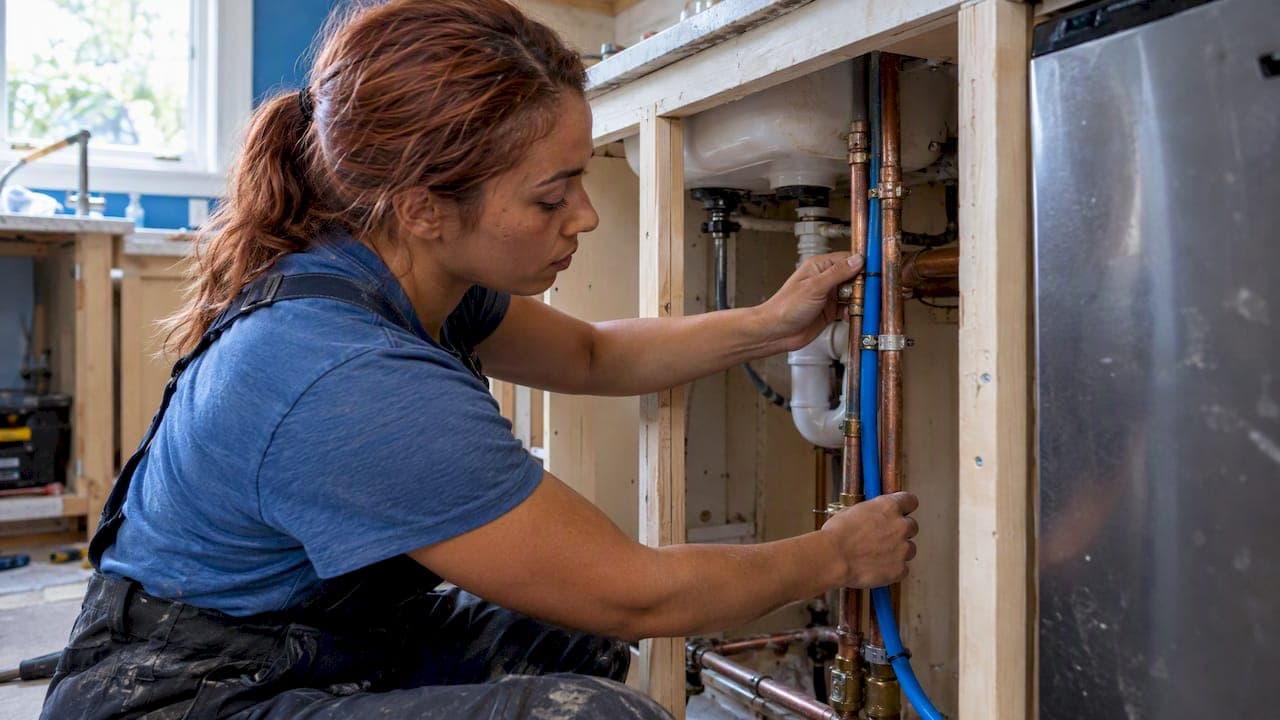
For most homes, PEX is the cheaper and faster choice, and copper is the longer-lived, more heat- and UV-tolerant choice. Neither is wrong. The right pipe depends on your budget, how much of the house is open, where the pipe runs and what your insurer says. This guide compares them on the points that decide a repair, repipe or remodel.
TL;DR
- PEX costs less to buy and install. One national guide puts a 1,500-square-foot, two-bath repipe at $4,000 to $6,000 in PEX and $8,000 to $10,000 in copper.
- Copper typically lasts 50 to 70 years. PEX typically lasts 30 to 50 years, and heat, chlorine and sunlight shorten that.
- PEX flexes, so it handles freezing better. Copper is rigid, resists UV and rodents, and suits exposed runs and spots near high heat.
- Both are accepted by model plumbing codes. Check what your insurer and local code officials require before you choose.
- A licensed plumber can match the pipe to your house, your water and your walls.
Table of Contents
- PEX vs copper at a glance
- What PEX and copper are
- Cost: what you pay for materials and labor
- Lifespan: how long each pipe lasts
- Freezing and cold snaps
- Sunlight, rodents and heat
- Other pipe materials
- Code, standards and what to look for
- Insurance: the PEX question
- Environmental and fitting differences
- Which is better for your situation
- Do plumbers recommend PEX?
- Our perspective
- Plan your repipe or repair with JoCo
- Questions to ask before you sign a repipe quote
- FAQ
- Sources
PEX vs copper at a glance
| Factor | PEX | Copper |
|---|---|---|
| Material | Flexible plastic tubing | Rigid metal pipe |
| Material cost per linear foot | About $0.50 to $2 | About $2 to $8 |
| Installation | Faster, fewer fittings | Slower, soldered joints |
| Typical lifespan | 30 to 50 years | 50 to 70 years |
| Freeze performance | Better (PEX-A and PEX-B expand) | Can split in a hard freeze |
| Sunlight (UV) | Needs protection | Resistant |
| Rodents | Can be damaged | Holds up better |
| Water chemistry | Sensitive to high heat and chlorine | Sensitive to highly acidic water |
Cost and lifespan figures come from Bob Vila's comparison. Your own numbers will vary with house layout, access and local labor, so treat them as ranges, not quotes.
What PEX and copper are
PEX is cross-linked polyethylene, a flexible plastic tubing. It bends around corners, so a plumber can run long lengths with few joints. Connections use crimp rings, clamps or push-to-connect fittings, according to Bob Vila.
Copper is the rigid metal pipe that homes have used for decades. Joints are usually soldered. Compression fittings can be used in some situations. Every turn and branch needs a fitting, which adds labor and material.

PEX also comes in types. PEX-A, PEX-B and PEX-C differ in how they are made, and that affects how they handle freezing, as covered below.
Cost: what you pay for materials and labor
PEX wins on price in nearly every comparison.
- Materials: Bob Vila lists PEX at about $0.50 to $2 per linear foot and copper at $2 to $8.
- Whole-house installation: the same guide says copper water pipes average 58% to 68% more than PEX to install. Its example is $8,000 to $10,000 for copper and $4,000 to $6,000 for PEX in a 1,500-square-foot, two-bath home.
- Labor: a 2026 U.S. cost guide estimates PEX labor at $2 to $6 per linear foot and copper labor at $4 to $12.
The gap comes from time. PEX needs fewer fittings and no soldering, so crews finish sooner. Copper needs more cuts, more joints and more hours.
The cheapest pipe is not always the cheapest job. Access, drywall repair, permits and the number of fixtures all move the total. For a Rogers-specific look at what a repipe costs, see our whole house repipe cost guide.
Lifespan: how long each pipe lasts
Copper has the longer track record. Bob Vila gives typical service life as 50 to 70 years for copper and 30 to 50 for PEX.
PEX has a documented design target too. The HUD and Plastic Pipe and Fittings Association design guide says potable-water PEX made to ASTM F876 must show a minimum extrapolated 50-year lifetime in an aggressive hot-chlorinated-water test at 140°F and 80 psi. That is a lab standard, not a promise about your house.
What shortens life:
- PEX: water at 180°F or higher, and high chlorine levels. Sunlight damages it too.
- Copper: highly acidic water, which can eat into the pipe over time.
Both warnings come from Bob Vila's comparison. If you have well water or unusually aggressive city water, test it before you pick a material. A water test costs little next to a repipe.
Freezing and cold snaps
PEX has the edge here. Per The Home Depot's guide, PEX-A and PEX-B expand when water freezes and resist cracking. PEX-C is more susceptible. The same guide says copper can break when temperatures stay below 20°F for at least six hours.
That matters most for pipes in attics, crawl spaces, exterior walls and garages. Any pipe can fail if it is exposed enough. Insulation and keeping pipes out of unheated spaces still count, whichever material you choose.

If a pipe has already burst, shut off the water first. Our guide to what to do when a pipe bursts covers the first 48 hours, and the burst pipe repair cost guide covers what repair runs.
Sunlight, rodents and heat
Copper is the better pipe where conditions are rough.
- UV: PEX breaks down faster in sunlight. The HUD and PPFA guide says it should not be installed outdoors unless it is buried or protected from UV, and that you should follow the manufacturer's exposure limits. Copper resists UV.
- Rodents: copper holds up better against gnawing animals, per The Home Depot.
- High heat: This Old House notes copper is usually preferred near high heat, such as close to a water heater flue, and where rigid pipe is needed.
This is why many homes end up with both materials. PEX runs through walls and floors, and copper stays on exposed or hot sections.
Other pipe materials
PEX and copper are not the only options. CPVC is a third rigid plastic that some homes use for supply lines, and we compare it in CPVC vs PEX. For drain and underground lines, the choice shifts to other materials. A PVC and corrugated pipe comparison shows how those differ for outdoor and buried use.
Code, standards and what to look for
PEX is accepted in the major model codes. A Plastic Pipe Institute presentation to the ICC lists PEX tubing and fittings in the IRC and IPC as of 2023. Local jurisdictions adopt and amend those codes, so your plumber and your city's building department have the final word.
The same presentation says that for potable water you should look for at least PEX 1006 printed on the tubing. That designation points to chlorine resistance, UV resistance and hydrostatic design strength. Read the markings on any PEX in your house or on a quote.
Insurance: the PEX question
Homeowners often ask why insurers can be wary of PEX. According to Blanchard Insurance, the concerns are UV, chlorine degradation and rodent damage. The same source says older PEX installations may face restrictions, while newer ones are generally more acceptable to insurers.
Coverage also depends on how a leak happens. The Insurance Information Institute explains that standard HO-3 policies cover accidental discharge of water from a plumbing system, while seepage is excluded as a maintenance issue. Your policy wording governs. Before a repipe, call your agent and ask whether the material, the installer or the install date affects your rate or coverage. Get the answer in writing.
Environmental and fitting differences
PEX needs fewer fittings than copper. A white paper from a PEX manufacturer says life-cycle assessments indicate a lower environmental impact for PEX. That is the manufacturer's perspective. Fewer joints do mean fewer places for a connection to fail, but a poor connection in any material leaks.
Copper is a metal that recyclers take back. If recycled content or end-of-life matters to you, ask your plumber about it.
Which is better for your situation
Whole-house repipe in a home with open access or a remodel: PEX is usually the pick. It is faster to run, costs less and bends through framing. Fewer wall openings mean less patching.
Small repair or a short addition: copper is often easier to match to existing copper. This Old House says copper is usually preferred for small remodeling projects.
Exposed runs, mechanical rooms, outdoors or near high heat: copper, or PEX with proper protection.
Cold-prone areas such as attics, crawl spaces and garages: PEX-A or PEX-B, insulated, is the safer bet.
Corrosion, pinholes or low pressure in an old house: that is often the sign it's time to repipe rather than patch. Old galvanized steel in particular is a common reason owners ask about a full repipe.
Well water or unusual water chemistry: test first. Acidic water points away from copper. Very hot water or high chlorine points away from PEX.
Do plumbers recommend PEX?
Many do for new work and repipes, because it saves time and cost and handles most conditions well. Many also keep copper in the plan for specific spots. A good plumber does not push one pipe for every house. They look at access, water, code and budget, then explain the tradeoffs.
Our perspective
Most people ask us which pipe is better. The better question is which pipe is better in your house.
When walls are open or a full repipe is on the table, PEX often gets the job done faster and at lower cost, with fewer joints to check. When a run is exposed, near heat, or tying into existing copper, copper is often the cleaner answer. We look at the layout, the water and the budget before we recommend anything.
We also tell homeowners to check their insurance and local code before work starts. A repipe is a large job. Knowing what your policy says about pipe material avoids surprises later.
Whichever material fits, we aim for licensed work, clear communication and a quote that spells out what you are paying for.
Jonathan
Plan your repipe or repair with JoCo
If you are weighing PEX and copper for a repipe, a leak repair or a remodel in Rogers, AR, we can look at your home and explain the options. Our whole house repiping service covers full supply-line replacement, and you can reach us through the JoCo Plumbing site to book an appointment.

If you already see wet spots, low pressure or a hidden leak, start with leak detection and repair. If water is running now, our emergency plumbing repairs team handles urgent calls.
Questions to ask before you sign a repipe quote
- Which material and type is quoted, and why? Ask for PEX-A, PEX-B or copper by name.
- Are the PEX markings at least 1006 for potable water?
- Which sections, if any, will be copper?
- How will pipes in attics, crawl spaces and exterior walls be insulated or protected?
- How much wall and ceiling patching is included?
- Does the quote include permits and inspection?
- Does my insurer need to know about the new pipe?
A quote that answers these clearly is easier to compare. For help reading an itemized quote on another job, see our tankless water heater cost breakdown.
FAQ
Is PEX better than copper?
Not in every case. PEX costs less, installs faster and handles freezing better. Copper lasts longer on average and resists UV, rodents and heat. For most open-access repipes PEX is the practical choice, and for exposed or hot locations copper is.
Which lasts longer, PEX or copper?
Copper, on typical estimates. Bob Vila cites 50 to 70 years for copper and 30 to 50 for PEX. Water temperature, chlorine, acidity and sunlight can shorten either.
Will PEX affect my homeowners insurance?
It can. Blanchard Insurance says older PEX installations may face restrictions and newer ones are generally more acceptable. Call your agent before a repipe and ask what they require.
Is PEX safe for drinking water?
PEX made for potable water is listed in model plumbing codes. Look for at least PEX 1006 on the tubing, per the Plastic Pipe Institute. Your local building department can confirm what is approved in your area.
Can I mix PEX and copper in one house?
Yes. Plumbers connect the two with transition fittings made for the purpose. Many homes use PEX for hidden runs and copper for exposed or high-heat sections.
Sources
- PEX vs. Copper: Which Pipes Are Best for Your Plumbing
- PEX vs. Copper Pipe: Which to Use on the Job
- PEX vs. Copper Pipes: Which is Better for My Home?
- Pex vs Copper Cost Guide for U.S. Homes
- Design Guide: Residential PEX Water Supply Plumbing Systems
- Plastic Pipe Institute presentation, ICC 815
- PEX Plumbing and Homeowner's Insurance
- Am I Covered? Insurance Information Institute
- The Superiority of PEX Over Copper for Plumbing Systems
- PVC vs Corrugated Pipe