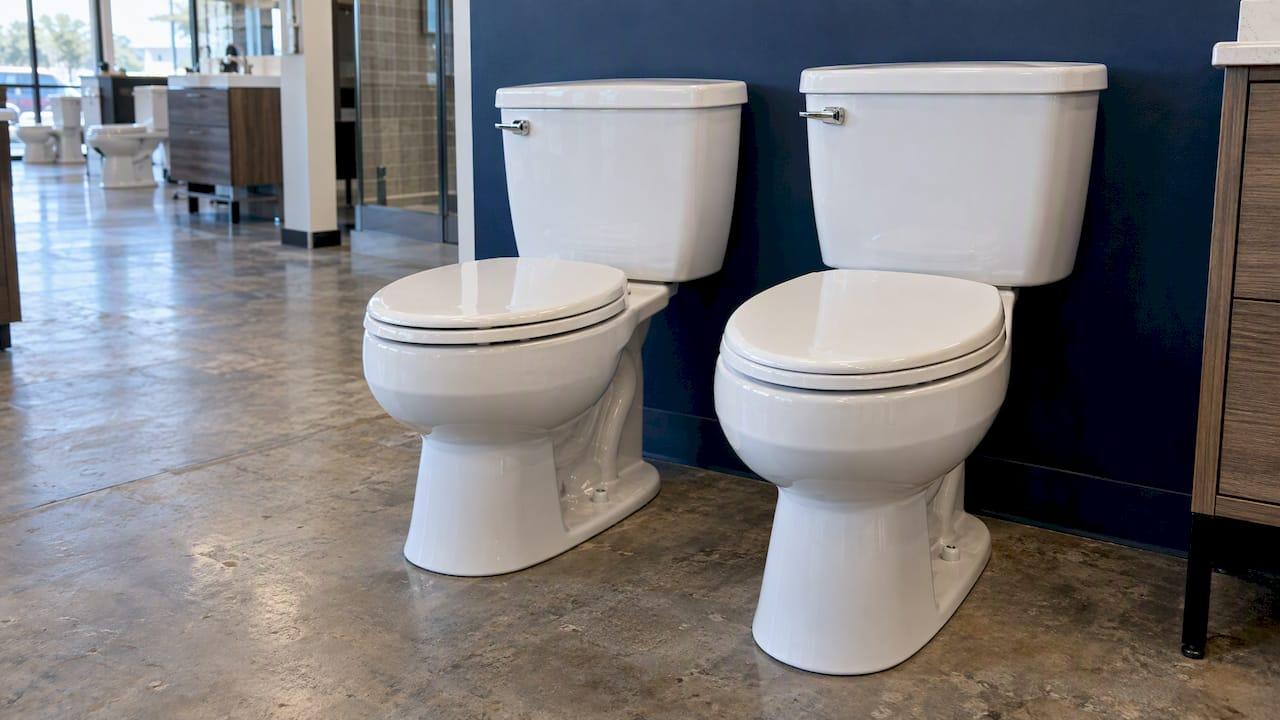
An elongated toilet has an oval bowl that is longer front to back. A round-front toilet has a shorter, rounder bowl. Elongated bowls are usually more comfortable for taller and larger users. Round bowls take up less room and often cost less. Pick elongated if the space allows it. Pick round if the bathroom is tight. Measure first, because the difference is only about 2 inches, and in a small room that is enough to matter.
This guide covers how to tell which toilet you have, the real size difference, comfort and cleaning, flushing, cost, and what to check before swapping one shape for the other.
TL;DR
- Elongated bowls are about 2 inches deeper than round-front bowls. Round is the better fit for small bathrooms and powder rooms.
- Elongated is generally the more comfortable shape for taller and larger people. Round is generally the lower-cost option.
- Both shapes use similar flush technology. Flush performance depends more on the specific model than on the bowl shape.
- You can replace round with elongated if the toilet fits and the door clears it. Check the rough-in and the space in front of the bowl first.
- Measure from the bolt holes to the front rim: about 16 1/2 inches is round, about 18 1/2 inches is elongated.
Table of Contents
- What is the difference between round and elongated toilets?
- How to tell which toilet you have
- Size and space: how much room does each need?
- Comfort: why people buy elongated toilets
- Cleaning and flushing: does shape matter?
- Cost: round vs elongated
- Can you replace a round toilet with an elongated one?
- Which one do plumbers prefer?
- Plan the toilet as part of the whole bathroom
- When to call a plumber
- Replacing a toilet in Rogers, AR
- FAQ
- Sources
What is the difference between round and elongated toilets?
The difference is the shape of the bowl and the seat that sits on it. Round bowls are circular. Elongated bowls are oval, longer and more pointed at the front, according to a guide on measuring for a toilet seat.
Everything else is largely the same. Round and elongated models come in similar heights, use the same rough-in sizes and use similar flush technologies, as Lowe's buying guide explains. You can find both shapes in one-piece and two-piece designs, standard height and taller "comfort" height.
So the choice comes down to four things:
- How much room you have.
- Who uses the toilet.
- Your budget.
- Whether you plan to add a bidet seat or another accessory.
How to tell which toilet you have
Look at the bowl from above. If the rim forms a circle, it is round. If it stretches into an oval, it is elongated.
If you want a number, measure it. American Standard says to measure from the center of the bolt holes at the back of the bowl to the front edge of the rim. A reading of about 16 1/2 inches means a round-front toilet. About 18 1/2 inches means elongated. Their support page gives these figures.
This matters most when you buy a replacement seat. A round seat will not sit correctly on an elongated bowl, and the reverse is also true. Measure before you shop.
Size and space: how much room does each need?
Round toilets typically project 25 to 28 inches from the finished wall. Elongated toilets typically project 27 to 30 inches, according to Family Handyman. Expect an elongated model to need about 2 inches more depth.

Two inches sounds small. In a half bath, a hall bath or a bathroom where the door swings inward, it can decide whether the door opens fully or hits the bowl.
Projection numbers vary by manufacturer and model, so treat the ranges as a guide. Always check the spec sheet for the exact toilet you are considering.
Measure the room before you choose
Use this quick check:
- Measure from the finished wall behind the toilet to the front of your current bowl.
- Add 2 inches if you are considering a switch from round to elongated.
- Open the bathroom door fully and check that it still clears the new bowl.
- Check the space in front of the bowl and to each side. Local building codes set minimum clearances, so ask your plumber or your city's building department what applies where you live.
A tape measure and ten minutes will save you a return trip to the store.
Rough-in: the measurement people forget
The rough-in is the distance from the wall behind the toilet to the center of the drain or the closet bolts. Common sizes are 10, 12 and 14 inches, per Lowe's. The most common is 12 inches.
A toilet made for a 12-inch rough-in will not fit a 10-inch or 14-inch setup. Measure from the wall behind the toilet to the middle of the bolts on its base. If the baseboard is thick, measure from the wall surface and not the trim.
Round versus elongated does not change the rough-in. It changes how far the bowl reaches into the room.
Comfort: why people buy elongated toilets
Elongated bowls give you more room up front. That is the main reason people buy them. Lowe's notes that elongated toilets may be preferable to larger and taller people. Many homeowners choose them for master baths and for any bathroom with space to spare.
Comfort is also personal. Family Handyman recommends testing different toilet heights to find what suits you. A showroom visit and a few seconds sitting on a display model tell you more than a spec sheet.
Height matters as much as shape. Many elongated toilets come in chair height, which sits higher and is easier to stand up from. If your issue is height and not bowl shape, a toilet seat raiser is one way to add height to an existing seat while you plan a replacement.

Who should choose round
Round toilets are the practical pick when:
- The bathroom is small, such as a powder room, a closet-sized half bath or a tight hall bath.
- The door swing leaves little spare room.
- You are working to a budget. Round toilets are generally less expensive and smaller, according to Family Handyman.
- The toilet is for children or a guest room, where the extra bowl length adds little.
A round toilet is a sound, standard choice. It is not a lesser one. In the right room it is the better one.
Who should choose elongated
Elongated toilets suit:
- Master bathrooms and larger family bathrooms.
- Taller or larger users who want more seating room.
- Homeowners planning a bidet seat. Many bidet and smart seats are made for elongated bowls, so check the seat's listed fit before buying.
- Remodels where the layout already has the extra 2 inches.
Cleaning and flushing: does shape matter?
Online forums argue about this a lot. The more reliable answer is that the flush system matters more than the outline of the bowl.
Lowe's says both shapes use similar flush technologies, and that elongated toilets can have a more powerful flush system. That is a model-level feature, not a rule. Look at the flush rating and the design of the specific toilet, such as the rim and the trapway.
For cleaning, a bigger bowl gives you more surface to reach, but the shape does not make a toilet clean itself. Rim design, glazing and how well the toilet is installed all play a part. A rocking or poorly sealed toilet can leak at the base no matter the shape, and that is a plumbing problem, not a bowl problem.
Seat availability is a small practical point. Lowe's notes that replacement seats for elongated toilets may be easier to find, which helps when a seat cracks or you want a different style.
Cost: round vs elongated
Round toilets may cost less. The gap is usually modest and depends on the brand, the height, the flush system and whether you choose a one-piece or two-piece design.
The bowl shape is only part of the bill. A replacement also includes removing and disposing of the old toilet, a new wax ring or flange hardware, a supply line, and labor. If the flange is damaged or the subfloor is soft, the job grows. Our toilet replacement cost guide walks through budget ranges, rebates and what to check before the work starts.
Can you replace a round toilet with an elongated one?
Yes, if there is enough space. Elongated bowls are about 2 inches deeper than round ones, so confirm the toilet fits and the door will not hit it, as Family Handyman advises.
Before you buy, check these:
| Check | What to confirm |
|---|---|
| Rough-in | The new toilet matches your current rough-in (10, 12 or 14 inches) |
| Depth | The extra 2 inches fits without blocking the door or tub |
| Side clearance | There is room on both sides of the bowl |
| Seat | You buy the seat shape that matches the new bowl |
| Flange | The floor flange is intact, level and at the right height |
The compact elongated option
If you want an elongated seat but have a round-size space, look at compact elongated models. American Standard states that a compact elongated bowl fits in the space of a round-front toilet with a 12-inch rough-in. It keeps the elongated seat in a footprint closer to a round one.
Check the manufacturer's spec sheet for exact projection before you commit. Compact does not mean identical to a round bowl in every dimension.
Which one do plumbers prefer?
Plumbers do not pick a shape. They pick the toilet that fits the room and the drain, and that the customer will be happy with. Install quality shapes the result more than the outline of the bowl. A well-set toilet on a sound flange, with the right wax ring and a tight seal, will outperform a poorly set one in either shape.
Our view on choosing a bowl shape
We replace toilets in Rogers homes of every age, and the shape question comes up on most jobs. Our advice is simple. Measure the room first, then decide.
In older homes, bathrooms are often tighter than newer builds. A round bowl is a good fit there, and it keeps the door swing clear. In larger or remodeled baths, we usually point customers toward elongated, because the added room up front is easy to live with.
What we care about most is what happens under the toilet. Before we set a new one, we look at the flange, the floor and the supply line. A new toilet on a damaged flange is a leak waiting to happen. If we find an issue, we tell you what it is and what it will take to fix before we go further.
If you are remodeling a bathroom, choose the toilet when you plan the layout, not after. The rough-in, the door swing and the vanity position all work together.
Jonathan
Plan the toilet as part of the whole bathroom
A toilet swap is a small job on its own. It is often one part of a bigger project. If you are remodeling a bathroom or kitchen, the shape, height and rough-in should be settled before walls and floors close up.
This is also when to look at what is behind the walls. Old supply lines, slow drains and aging shutoff valves are cheaper to deal with while the room is open. Whole-house repiping is worth considering if the home has failing pipes.
When to call a plumber
You can swap a toilet yourself in some homes. Call a licensed plumber when:
- The toilet rocks, or water seeps from the base.
- The floor around the toilet feels soft.
- The flange is cracked or sits below the finished floor.
- You find a slow drain or repeated clogs. A camera inspection can show what is happening in the line.
- You are moving the toilet or changing the rough-in.
In those cases, a new toilet will not solve the underlying problem.
Replacing a toilet in Rogers, AR
JoCo Plumbing handles toilet repair and installation for homes and businesses in Rogers, AR and the surrounding area. Our licensed technicians can check your rough-in and clearances, advise on bowl shape, and install the toilet. If a leak or a drain issue is behind the problem, we address that too.

For a toilet replacement, a bathroom remodel or a leak you cannot trace, contact JoCo Plumbing to book an appointment. If water is already spreading, see our emergency plumbing repairs page.
FAQ
Why do people buy elongated toilets?
Most buyers choose elongated toilets for comfort. The longer bowl gives more seating room, which suits taller and larger users. Many bidet seats are also made for elongated bowls. They are best where the room can handle the extra depth.
Do most homes have round or elongated toilets?
Both are common. Round toilets are widely found in older homes and small bathrooms. Elongated toilets are the usual choice in many newer builds and remodels. The best way to know what your own home has is to measure from the bolt holes to the front rim.
Can I replace a round toilet with an elongated toilet?
Yes, if it fits. The elongated bowl is about 2 inches deeper, so check the door swing, the side clearance and your rough-in. A compact elongated model is an option when space is tight. A plumber can confirm the fit before you buy.
Is an elongated toilet better at flushing?
Not by shape alone. Both shapes use similar flush technologies. Some elongated models have a more powerful flush system, but that is a feature of the model. Compare the flush design of the specific toilet you plan to buy.
Does a round or elongated toilet need a different rough-in?
No. Rough-in is the distance from the wall to the drain, usually 10, 12 or 14 inches, and it applies to both shapes. Measure it before you shop so the new toilet matches your existing drain.
Sources
- How do I know if my toilet seat is round front or elongated? (American Standard)
- How to Measure for a Toilet Seat (The Spruce)
- Round vs Elongated Toilet: Pros, Cons and Best Fit Guide (Family Handyman)
- Elongated vs Round Toilets: Which Should I Choose? (Lowe's)
- Compact Cadet 3 Right Height Elongated Toilet (American Standard)
- Toilet seat raiser