
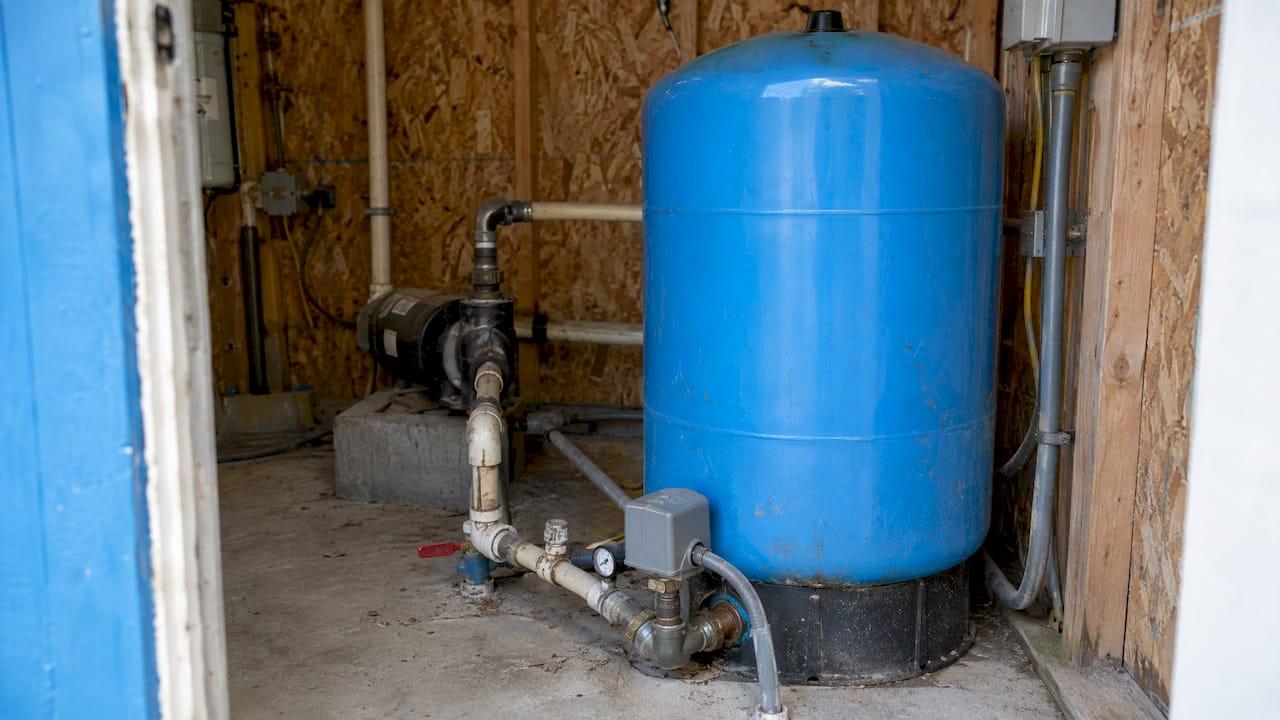
When a well pump stops working, you get no water, weak pressure, or a pump that will not shut off. Start with power: confirm the house has electricity, then look at the pump breaker. If power is fine, the fault is usually the pressure switch, the pressure tank, a check valve, a line break or the pump itself. Anything involving the well, the wiring at the pump or a pump that needs pulling is a job for a licensed professional. In Rogers and the surrounding area, that is the work our well pump repair and installation team does.
TL;DR
- No water at all: first confirm other circuits have power, then check the well-pump breaker or fuse. If resetting it does not fix the problem, call a licensed professional.
- Rapid on-and-off cycling usually points to the pressure tank, not the pump. Sputtering faucets point to air in the lines. A pump that never stops points to a stuck check valve or a leak in the line.
- Do not open the well cap to look inside. It can let contamination in.
- A pump that is tripping breakers, overheating or silent after a reset needs a professional diagnosis before it is replaced.
- Fix problems early. Winter repairs can be harder or cost more.
Table of Contents
- Start here: what the symptom tells you
- Step 1: Check power before anything else
- Step 2: Listen and look at the pressure tank
- Step 3: Read the air and the noise
- Step 4: A pump that will not stop running
- Step 5: Know why a motor overheats and shuts off
- What not to do
- Signs the pump is failing and when to replace it
- A note on water quality after a failure
- Who this matters for
- Our view on well pump problems
- Get the water back on
- FAQ
- Sources
Start here: what the symptom tells you
A well system has more parts than a pump. Water comes up from the well through a pump, passes a check valve, fills a pressure tank, and a pressure switch turns the pump on and off based on pressure. A failure in any of these can look like "the pump is dead." The symptom narrows it down quickly.
| What you see | Likely area | First step |
|---|---|---|
| No water, no sound from the pump | Power: breaker, fuse, pressure switch, wiring | Check the breaker and other circuits |
| Pump clicks on and off every few seconds | Pressure tank (waterlogged or lost air charge) | Stop using water and call for a tank inspection |
| Faucets sputter, water looks milky then clears | Air in the lines | Note when it happens and call a pro |
| Pump runs constantly | Check valve stuck open or line break | Shut the pump off at the breaker if you hear running water outside |
| Breaker keeps tripping | Motor drawing too many amps, wiring or pump fault | Leave the breaker off and call |
| Pressure drops slowly over weeks | Pump wear, clogged fittings, falling water level | Schedule an inspection |
This table is a guide to where to look, not a diagnosis. Several of these problems overlap, and a pressure tank fault can wear out a good pump if it is left alone.
Step 1: Check power before anything else
University of Nebraska extension guidance for private well owners gives the same first move: turn on appliances on a different circuit. If they work, the house has power, and the problem is on the well circuit. Then check the well-pump breaker or fuse. If resetting it does not correct the problem, the guidance says to contact a licensed professional.
Two things matter here.
- Reset a tripped breaker once. If it trips again right away, stop. Repeated resets on a breaker that keeps tripping can damage the motor or wiring, and the trip is telling you something is drawing too much current.
- Look at the panel, not the pump. Checking a breaker is a safe homeowner task. Opening the pressure switch cover, touching wiring or working near the wellhead while power is on is not.
Power problems are not always the breaker. A blown fuse, a failed pressure switch or damaged wiring between the panel and the pump can all stop power from reaching the motor. Those need a licensed plumber or electrician who can test them safely.
Step 2: Listen and look at the pressure tank
If the power is fine, go to the pressure tank, usually a large tank near where the water line enters the house. You are not opening anything. You are looking and listening.
Rapid cycling. A pump that turns on and off in short bursts is called short-cycling. Arizona's 2026 Domestic Well Owner's Toolkit says this is often caused by a waterlogged pressure tank, where the bladder or diaphragm has failed or lost its air charge. The tank can no longer hold a cushion of water, so pressure rises and falls fast and the pump starts and stops constantly.
This matters for your wallet. Each start puts stress on the motor. Treating a tank problem as a pump problem means paying for the wrong repair, and ignoring it can shorten the life of a good pump. We handle pressure tank repair and installation alongside pump work, so the whole system gets looked at together.
What a waterlogged tank feels like at home: pressure that surges and drops during a shower, lights or sounds from the pump cycling when a single faucet is open, and a pump that seems to run far more than it used to.
Step 3: Read the air and the noise
Sputtering faucets or milky water that clears after standing can mean air is getting into the lines. According to the same Arizona toolkit, this may mean the pump is drawing air because the water level has dropped to the pump inlet, or because there is a leak on the suction side.
That has a practical meaning. A pump sitting at the edge of the water level is working with little margin. In dry stretches, a well that always produced enough water can start pulling air. Running a pump with too little water around it is hard on the motor.
The same toolkit notes two ways to protect a system from low water levels: installing a submersible pump protection device that monitors load and power conditions, or reducing the pumping rate and increasing water storage. Both are decisions to make with a pump contractor who knows your well depth and pump setup.
Step 4: A pump that will not stop running
If the pump runs and runs, Nebraska's extension guidance says the cause may be a stuck-open check valve or a break in the water line between the well and the building, or within the building plumbing. A check valve is a one-way valve that keeps water from draining back down the well. When it fails, the pump has to keep re-pressurizing the system.
Here is a simple way to separate a plumbing leak inside the house from a line break outside. Turn off every tap and appliance, then watch whether the pump still cycles or runs. If it does, water is going somewhere. Look for a soggy patch, a sunken spot in the yard or an unexplained spike in your utility use. If you suspect a buried line, these checks for a hidden leak help you tell a real leak from pipe noise.

A suspected underground break is something we locate and repair. See our pages on underground and yard line water leak repair and main water line repairs. When the line is buried, a plumbing video camera inspection can show what is happening inside a pipe without guessing.
Step 5: Know why a motor overheats and shuts off
A submersible or jet pump motor has built-in protection. A shallow-well jet pump troubleshooting chart from the Open Textbook BC plumbing series lists several reasons a motor may overheat and shut off: voltage that is not within 10% of its rating, improper wiring or sizing, or an impeller rubbing against the pump case.

In plain terms, a pump that starts, runs briefly and then goes quiet may not be dead. It may be protecting itself. Resetting it repeatedly is the wrong response. The cause could be electrical, mechanical or a sizing problem, and finding it takes meters, access to the wiring and often pulling the pump.
What not to do
When the water stops, the temptation is to go look at the well. Don't. The Town of Hampstead, New Hampshire's Water Well Handbook advises homeowners not to open the well to look around, because opening it can introduce contamination, and says to call a well contractor if the well itself is suspected.
A short list of other things to leave alone:
- Do not touch the pressure switch contacts or wiring with the power on.
- Do not keep resetting a breaker that trips.
- Do not run the pump dry to "see if it catches."
- Do not assume a no-water problem means a new pump. Power, switch, tank, check valve and lines are all cheaper to fix when they are the cause.
Signs the pump is failing and when to replace it
A pump rarely fails without warning. Watch for:
- Pressure that drops gradually, or comes and goes
- Sputtering and air in the lines
- The pump running longer than it used to
- A breaker that trips when the pump starts
- No water even though power, switch and tank have been ruled out
Repair or replace? The answer depends on what failed. A switch, a check valve or a tank is a repair of that part. A motor that has burned out, a pump that has worn out, or one that keeps failing because it was the wrong size for the well usually points toward replacement. A good diagnosis separates these before anything is pulled from the well.
Timing matters. The Hampstead handbook advises addressing well issues promptly, noting that repairs in winter may not be possible or may cost more. Since a well pump failure can leave a household with no water at all, waiting for a convenient time is rarely a good plan. For pricing, see our well pump replacement cost guide, which breaks down what affects the total.
A note on water quality after a failure
Once the water is back, a well owner should keep testing the water. The Arizona toolkit notes that groundwater chemistry may change during droughts, which can raise levels of contaminants such as arsenic, uranium, iron and manganese, and that regular testing is needed. If a pump problem followed a long dry spell, build that into your plan. For taste, staining or scale, we install whole house water treatment systems.
Who this matters for
- Homeowners: the water stops at the worst time. The power and tank checks above take minutes and give a plumber something concrete to work from.
- Property managers and businesses: a well-fed building with no water has tenants or customers affected right away. Keep a record of when the pump was last serviced and who to call.
- First-time homebuyers on a well property: ask for the pump and pressure tank to be inspected as part of your home inspection, and know the age of both. Our plumbing inspection and camera services cover the lines too.
- Renovators: adding a bathroom or kitchen raises demand on the well. Have the pump and tank sized for the new load before the fixtures go in.
Our view on well pump problems
We see well pump trouble as a system problem first and a pump problem second. Power, pressure switch, pressure tank, check valve and water line all decide whether water reaches the tap.
That is why we look at the full system before recommending a replacement. If the cause is a tank or a leak in the line, replacing the pump does not fix it. If the pump is the cause, you get the right fix once.
Our focus is rapid response and transparent pricing from licensed technicians. We cover well pumps along with pressure tanks, leak detection and water line repair, so one team can follow the problem wherever it goes.
Jonathan
Get the water back on
If you have run the power check and the symptoms above point past a breaker, we can take it from there. JoCo Plumbing handles well pump repair and installation in Rogers, AR and the surrounding area, and our team also covers pressure tanks, water line repairs and leak detection.

No water is an emergency. Book through our emergency plumbing repairs page and tell us what you checked and what you saw: breaker status, pump noise, pressure behavior. It speeds up the diagnosis.
FAQ
Why is there no water coming from my well pump?
The most common starting point is power. Check that other circuits work, then look at the well-pump breaker or fuse. If resetting does not fix it, the pressure switch, wiring, check valve or the pump itself could be at fault, and a licensed professional should diagnose it.
How do I know if it is the pump or the pressure tank?
A pump that switches on and off every few seconds usually points to a waterlogged pressure tank that has lost its air charge. A pump that is silent with no power at the switch points to electrical causes. A pump that runs but delivers little or no water points toward the pump, the check valve or a line problem.
What are the signs of well pump failure?
Watch for falling pressure, sputtering faucets, air or milky water that clears, a pump that runs longer or constantly, and a breaker that trips. Any of these is a reason to schedule an inspection before the water stops completely.
Can I look inside the well myself?
No. Opening the well can introduce contamination, and a well contractor should be called if the well itself is suspected. Stick to checks at the breaker panel and a visual look at the tank.
When should a well pump be replaced?
Replace it when the motor or pump has worn out or burned out, or when it keeps failing because of its size or the conditions in the well. A proper diagnosis should rule out the switch, tank, check valve and lines first, since those are repaired separately.
Sources
- Private Drinking Water Wells: Operation and Maintenance, University of Nebraska Extension
- Arizona Domestic Well Owner's Toolkit, 2026
- Shallow Well Jet Pump Troubleshooting Chart, Open Textbook BC
- Hampstead Water Well Handbook