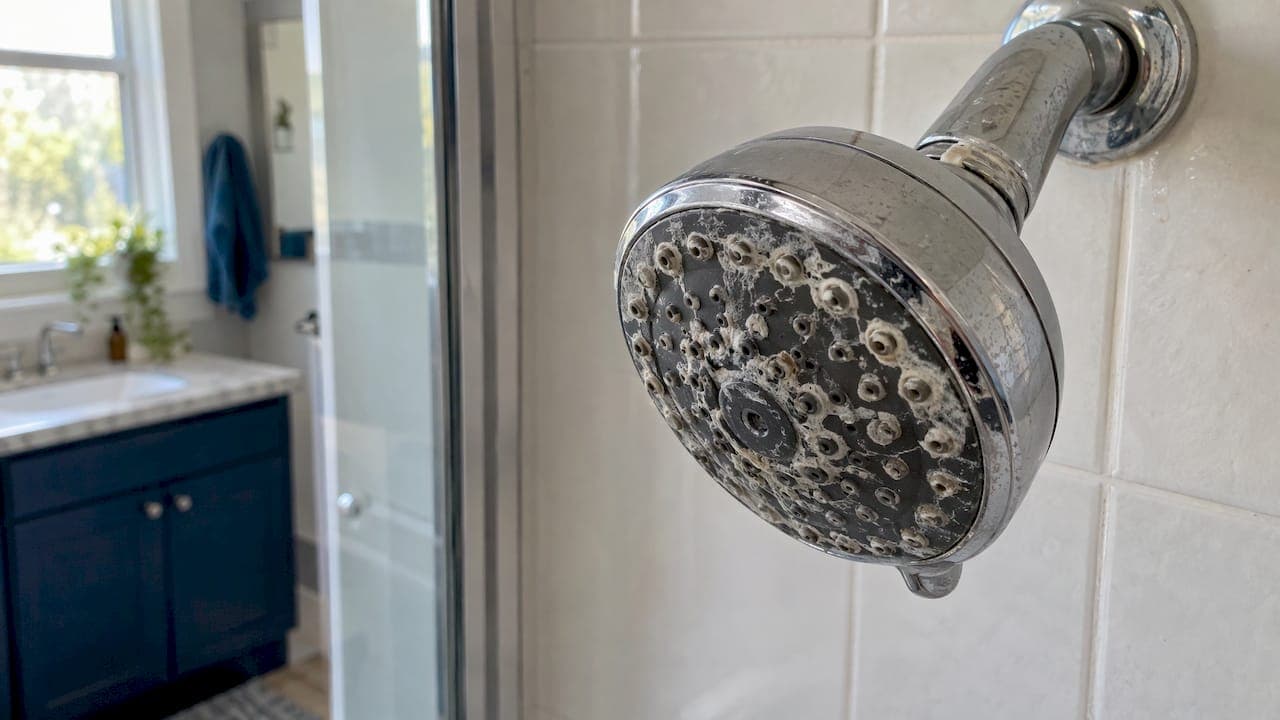
Hard water usually shows itself in a few predictable ways: white, chalky scale on faucets and showerheads, spots on glassware, soap that will not lather, and stiff or dingy laundry. Any one of these can have other causes. Several together point to dissolved calcium and magnesium in your water. You can confirm it with a simple soap test or a hardness reading from your water supplier, then decide how to deal with it.
Below, we walk through each sign, what causes it, how to test, which look-alike problems are not hard water, and when scale becomes a plumbing job.
TL;DR
- Hard water means high levels of dissolved calcium and magnesium. It is not a health hazard, but it is a nuisance on fixtures, in appliances and in the laundry.
- The most common signs: white scale on fixtures, spotted dishes, soap scum, poor lather, stiff laundry and a water heater that works harder.
- Confirm it with a soap test, a test strip or your supplier's water quality report. A lab test is the most accurate.
- Brown or orange stains, a rotten-egg smell, colored water or sudden pressure loss are not typical hardness signs. Those need a closer look.
- If scale keeps returning or affects flow and appliances, a plumber can assess the system and a softener can address the cause.
Table of Contents
- What hard water is
- Nine hard water symptoms to look for
- How to tell if you have hard water
- What can look like hard water but is not
- How hard water affects your plumbing
- Cleaning up hard water deposits
- Perspective: why we treat the cause
- When scale needs a plumber
- Fixing the cause: softeners and whole house treatment
- Water softener installation in Rogers
- FAQ
- Sources
What hard water is
Water picks up minerals as it moves through soil and rock. Hard water contains high amounts of dissolved calcium and magnesium, the two most common minerals behind hardness. Nothing is added to the water. The minerals are simply there, and they leave visible traces wherever water evaporates or gets heated.
Hardness is measured in milligrams per liter (mg/L) or grains per gallon. Penn State Extension notes that water under 60 mg/L of total hardness is considered soft, and anything above 180 mg/L is very hard. Most homes fall somewhere in between, which is why the signs can be mild at first and get more obvious over the years.
For a local reference point, Beaver Water District, a large northwest Arkansas water supplier, posts finished-water reports. A September 2026 report listed hardness at 78 mg/L. That sits above the soft range and well below the very hard range, so noticeable spotting and scale are realistic in many Northwest Arkansas homes, especially where water is heated. Your own supplier's figures are the ones that matter for your address.

Nine hard water symptoms to look for
1. White, chalky scale on faucets and showerheads
This is the classic sign. Health and utility sources describe whitish-gray scale on glass shower doors, bathroom and kitchen fixtures and kettles. Glendale Water and Power also lists white or chalky deposits on plumbing, tubs, sinks, pots and pans.
Look closely at the base of the faucet, the aerator and the showerhead holes. If you see crust or the spray pattern has gone uneven, minerals are collecting there.
2. Spots and film on dishes and glassware
Glasses come out of the dishwasher cloudy or speckled. Silverware looks dull. The spots are dried mineral left behind as water evaporates. A rinse aid may hide it, but the spots come back.

3. Soap scum on tubs, showers and sinks
Calcium and magnesium react with soap and leave a sticky film instead of rinsing away. If you scrub the tub often and the ring keeps returning, this is a likely cause. Cleaning is harder in hard water, and so is laundering.
4. Soap and shampoo that will not lather
Poor lather is one of the more reliable indicators. State health guidance lists reduced soap lather as a sign. You end up using more product to get the same suds, and your hands or hair can feel coated after rinsing.
5. Stiff, dingy or gray-tinged laundry
Minerals stay in fabric, and detergent does not work as well. Whites look dull, towels feel rough and clothes can show gray staining after washing.
6. Buildup in the coffee maker, kettle and iron
Anything that heats water collects scale. If your coffee maker slows down or you see white flakes in the kettle, that is mineral deposit. Running white vinegar through these appliances is a commonly recommended cleaning step, and Connecticut's health department fact sheet says vinegar and lemon juice can also loosen deposits on glass.
7. A water heater that works harder or fails sooner
Heating hard water causes solid calcium carbonate to form. The U.S. Geological Survey explains that scale can shorten equipment life, raise water-heating costs and clog pipes, and that it lowers the efficiency of electric water heaters. Signs at home include popping or rumbling noises from the tank, slower recovery and higher energy bills. If your heater is not producing hot water at all, see our guide to five checks for a water heater that is not heating.
8. Lower flow from fixtures
Scale narrows aerators, showerheads and washing machine inlet screens. Flow drops gradually. If it drops everywhere in the house at once, or suddenly, scale is less likely to be the cause (see the look-alikes below).
9. Dry-feeling skin and hair after washing
Many people report this, and it is common in articles on the topic. The cause is the soap film and mineral residue that rinse poorly. We treat it as a supporting clue, not proof. Skin conditions have many causes. If you have a rash or persistent irritation, talk to a doctor or dermatologist.
How to tell if you have hard water
Symptoms give you a suspicion. A test gives you a number. There are three practical routes.
| Method | Cost and effort | Accuracy | Best for |
|---|---|---|---|
| Soap shake test | Free, five minutes | Rough | A first check |
| Test strip or kit | Inexpensive, quick | Less precise, color chart | Getting a ballpark number |
| Supplier report | Free | Reflects treated water leaving the plant | City water customers |
| Independent lab | Fee, mailed sample | Most accurate | Wells, softener sizing |
The soap shake test
Fill a clean, clear bottle about one-third with tap water. Add a few drops of pure liquid soap, cap it and shake hard for ten seconds. In hard water you get little foam and cloudy water. In soft water you get plenty of suds and clearer water underneath. Use plain soap, not a detergent with added softeners, or the result will mislead you.
Test strips
Dip a strip, wait the stated time and compare it with the color chart. Strips are fast and cheap, and good enough to tell soft from hard. They are not a basis for sizing equipment.
Your water supplier's report
Public water systems must provide annual water quality reports. These may include hardness, and you can ask your supplier for the figure. Compare it with the 60 mg/L and 180 mg/L markers above.
Private wells
If you are on a private well, nobody reports for you. The EPA's home water testing fact sheet says the homeowner is responsible for making sure an individual supply is safe, and it recommends testing for hardness every three years as part of routine testing. Use a lab for a well.
One limit applies to every hardness test: it does not tell you anything about bacteria, lead, nitrate or other contaminants. If you have safety concerns about your water, ask for a separate test for those.
What can look like hard water but is not
Some household clues get blamed on hardness when something else is going on.
- Brown, orange or red stains. These usually point to iron or rust, not calcium. Hardness scale is white or light gray.
- A rotten-egg smell. This is not a normal sign of hardness. Have it checked.
- Colored or cloudy water straight from the tap. Worth investigating, not assuming.
- A sudden drop in pressure. Scale builds slowly. A sudden or severe change can come from a leak, a failing valve or a line problem.
A water advisory site summarizing these points also says that repeated residue or scale affecting appliances and flow is the point where measuring and treating is worth it, while sudden changes call for closer investigation. We agree with that split. Slow, white, crusty buildup is a hardness problem. Sudden, colored or wet is a plumbing problem.
How hard water affects your plumbing
The effect is cumulative. Mineral deposits form wherever water sits, evaporates or gets heated. Over time:
- Pipes gradually narrow as scale lines the inside, which reduces flow and can contribute to clogs.
- Water heaters lose efficiency as scale insulates the heating surfaces. Tanks collect sediment at the bottom.
- Fixtures such as faucets, valves and showerheads crust over and wear faster.
- Appliances that heat or move water, like dishwashers and washing machines, carry the same buildup.
The USGS summary covers these points: scale can reduce equipment life, raise heating costs and clog pipes. If you are planning a replacement, the water heater replacement cost guide and our comparison of tankless and tank water heaters can help you plan around your water quality.
Cleaning up hard water deposits
Cleaning treats the symptom. It does not stop the minerals from returning, but it is the right first step for visible buildup.
- Glass, tile and fixtures: White vinegar and lemon juice can help dissolve deposits. Soak a cloth with vinegar, wrap it around the faucet for a while, then wipe.
- Showerheads: Soak in vinegar in a bag or bowl, then rinse and clear the holes.
- Dishwasher and coffee maker: Run vinegar through a cycle, as the Connecticut fact sheet describes.
- Tile and grout: Stains on porous grout and natural stone need more care than glass. Tips for removing hard water stains from tile cover that surface in detail.
Do not use vinegar on natural stone unless the manufacturer says it is safe, and never mix vinegar with bleach or other cleaners.
Perspective: why we treat the cause
We see the same pattern on service calls in Rogers. A homeowner has cleaned the same showerhead four times, replaced a faucet, and is now looking at a water heater that is losing performance. The scale was the common thread all along.
Our view is simple. Cleaning handles what you can see. A water softener or whole house treatment system handles what is dissolved in the water before it reaches your fixtures, heater and appliances. That is why we install them as part of our water treatment work, alongside the plumbing itself.
Sequence matters. The soft-water switch is easier when a licensed plumber looks at the system first: water heater condition, aerators and screens, pipe condition, and where the softener should tie in. Glendale's utility notes that softening a house with older plumbing that was never softened can loosen deposits that clog washer screens, showerheads, filters or aerators. Knowing that in advance keeps the first weeks smooth.
Our approach is to measure first, explain the options in plain language and install the system that fits your household and water.
Jonathan
When scale needs a plumber
Scale alone is a maintenance issue. Call a plumber when it combines with other signs:
- Low flow throughout the house that cleaning aerators and showerheads does not fix.
- A water heater that is noisy, slow to recover or no longer heating, especially an older tank.
- Repeated drain slowdowns. Our drain cleaning and repair service includes camera inspection and jetting when buildup is inside the lines.
- Older galvanized or heavily scaled pipes where repiping may be the lasting answer. See whole house repiping and plumbing solutions.
- Any sudden pressure loss, wet spots, colored water or a smell. That is an emergency plumbing or leak question, not a hardness one.
If you are not sure which category you are in, describe what you see when you call. Slow white crust is one conversation. A sudden change is another.
Fixing the cause: softeners and whole house treatment
A water softener removes the calcium and magnesium that cause hardness. It is installed on the main water line, so every tap, the water heater and the appliances get treated water.
What to think about before you choose:
- Your actual hardness. Use a lab result or supplier report, not a guess. It drives the sizing.
- Household size and water use. More people and more laundry mean more demand on the system.
- Space and drain access. The unit needs a spot near the main line, power and a drain.
- Other water concerns. If taste or odor is the issue, filtration is a separate step. We offer carbon filtration and whole house water treatment systems for that. Our whole house filter cost guide lays out budget tiers.
- Budget. Our water softener installation cost guide explains what drives the price and how to compare quotes.
Take the hardness result with you when you request quotes. A plumber who sees the number can size the system and tell you what to expect.
Water softener installation in Rogers
If your signs point to hard water, JoCo Plumbing installs water softeners for homes and businesses in Rogers, AR and the surrounding area. Our licensed technicians check your plumbing, size the system to your household and install it cleanly. We aim for transparent pricing, so you know the scope before work starts.

See water softener installation for details, or visit JoCo Plumbing to book. Call now if you have a leak, low pressure or other urgent issue.
FAQ
How do you tell if you have hard water?
Start with the signs: white scale on fixtures, spotted glasses, soap scum and poor lather. Then run a soap shake test. Little foam and cloudy water suggests hard water. For a number, use a test strip, your supplier's water quality report or a lab.
Is hard water bad for your health?
No. University extension guidance describes hard water as not a health hazard but a household nuisance. It affects fixtures, soap and detergent performance. A hardness test does not check for contaminants, so test separately if you have other concerns.
Does hard water damage pipes and water heaters?
It can. Heating hard water forms calcium carbonate scale. The USGS says scale can reduce equipment life, raise heating costs and clog pipes. The effect builds slowly, so early action costs less.
How do I get rid of hard water?
Cleaning removes visible deposits. White vinegar or lemon juice works on many surfaces. To stop the buildup, you have to reduce the minerals in the water, which is what a water softener does. A plumber can size and install one for your home.
What if my stains are brown or orange?
That points to iron or rust, not hardness. A rotten-egg smell, colored water or sudden pressure loss also needs a closer look. Contact a plumber to inspect the lines and fixtures.
Sources
- Drinking Water: Hard Water, University of Nebraska-Lincoln Extension
- Water Tests for Households Using Public Water Supplies, Penn State Extension
- Hardness of Water, U.S. Geological Survey
- Hardness in Drinking Water, Vermont Department of Health
- Water Hardness, City of Glendale, CA
- Hardness Fact Sheet, Connecticut Department of Public Health
- Fact Sheet: Home Water Testing, U.S. EPA
- How to Test for Hard Water, The Spruce
- 12 Signs of Hard Water in Your Home, Water Advisor
- NWA Drinking Water Quality Reports, Beaver Water District